
Quick answer: Before you hire a solar repair technician, ask about their licence and insurance, their experience with your exact equipment brand and fault, how they diagnose problems, what the repair will cost in writing, whether parts and labour are guaranteed, how long the job will take, and what happens if the repair does not fix the problem. Get at least two or three written quotes, check reviews and references, and never pay the full amount up front. A good technician welcomes these questions and answers them clearly; a technician who dodges them, pressures you to decide today, or cannot show proof of insurance is a warning sign. This guide gives you the 15 questions that matter most, explains what a good answer sounds like, and shows you the red flags to walk away from.
Table of Contents
- Why These Questions Matter
- Before You Call: What to Know About Your System
- 1. Are You Licensed and Insured?
- 2. How Much Experience Do You Have With My Equipment?
- 3. How Will You Diagnose the Problem?
- 4. What Exactly Will the Repair Involve?
- 5. What Will It Cost — in Writing?
- 6. Will You Use Genuine Parts?
- 7. What Warranty Do You Offer on the Repair?
- 8. How Long Will the Repair Take?
- 9. How Do You Work Safely?
- 10. Can You Help With a Warranty Claim?
- 11. What Happens If the Repair Does Not Fix It?
- 12. Can I See Reviews or Speak to Past Customers?
- 13. How and When Do I Pay?
- 14. What Happens to My Roof and the Mounting?
- 15. Will You Check the Whole System Afterwards?
- How to Compare Quotes Fairly
- Red Flags: When to Walk Away
- What Good Answers Sound Like
- When to Call a Professional
- FAQs
- Conclusion
Why These Questions Matter
A solar system is an expensive piece of equipment wired into your home’s electrics and fixed to your roof. A bad repair can do more than waste money: it can void a manufacturer warranty, damage your roof, create an electrical hazard, or leave your system producing less power than before. Yet many homeowners hire the first technician who answers the phone, without checking whether that person is qualified to touch their system at all.
Solar repair is a specialist trade. A general electrician may be excellent with household wiring but unfamiliar with inverter error codes, DC isolators, optimisers or battery management systems. A roofer may know roofs but not the electrical side. And a salesperson in a van may know how to sell a new system but not how to repair an old one. The questions in this guide help you tell the difference.
Asking questions is not rude, and it does not mean you distrust the technician. Good tradespeople expect to be asked about licences, insurance and experience — it is part of their job, and most are happy to show their credentials. The technicians worth hiring are the ones who answer patiently and in plain language. If someone treats your questions as an inconvenience, that tells you something important before any work starts.
There is also money at stake. Solar repair costs vary widely between companies, and a written quote can differ by hundreds of pounds or dollars for the same job. Asking the right questions before work begins is the simplest way to avoid surprise charges, unfinished work and disputes later.
Before You Call: What to Know About Your System
You will get better answers — and better quotes — if you can describe your system before the technician arrives. Spend ten minutes gathering the basics:
- Panel and inverter brands and models: check the labels on your inverter and on the back of a panel, or look at your original contract and quote.
- System size and age: how many kilowatts, and when it was installed.
- The fault: what exactly is happening? An error code on the inverter display, zero output on a sunny day, a tripped breaker, a leak, a cracked panel, or a monitoring app showing no data?
- Error codes and readings: write down any error code, flashing light pattern, or message from your monitoring app, and note when the problem started.
- Photos: take clear photos of the inverter display, any visible damage, and the equipment labels. A technician who sees these in advance can often tell you whether the job is in their area of expertise.
Having this information ready shows the technician you are organised, and it stops the conversation from drifting into vague guesses. It also helps you compare quotes fairly, because every company is pricing the same described problem.
1. Are You Licensed and Insured?
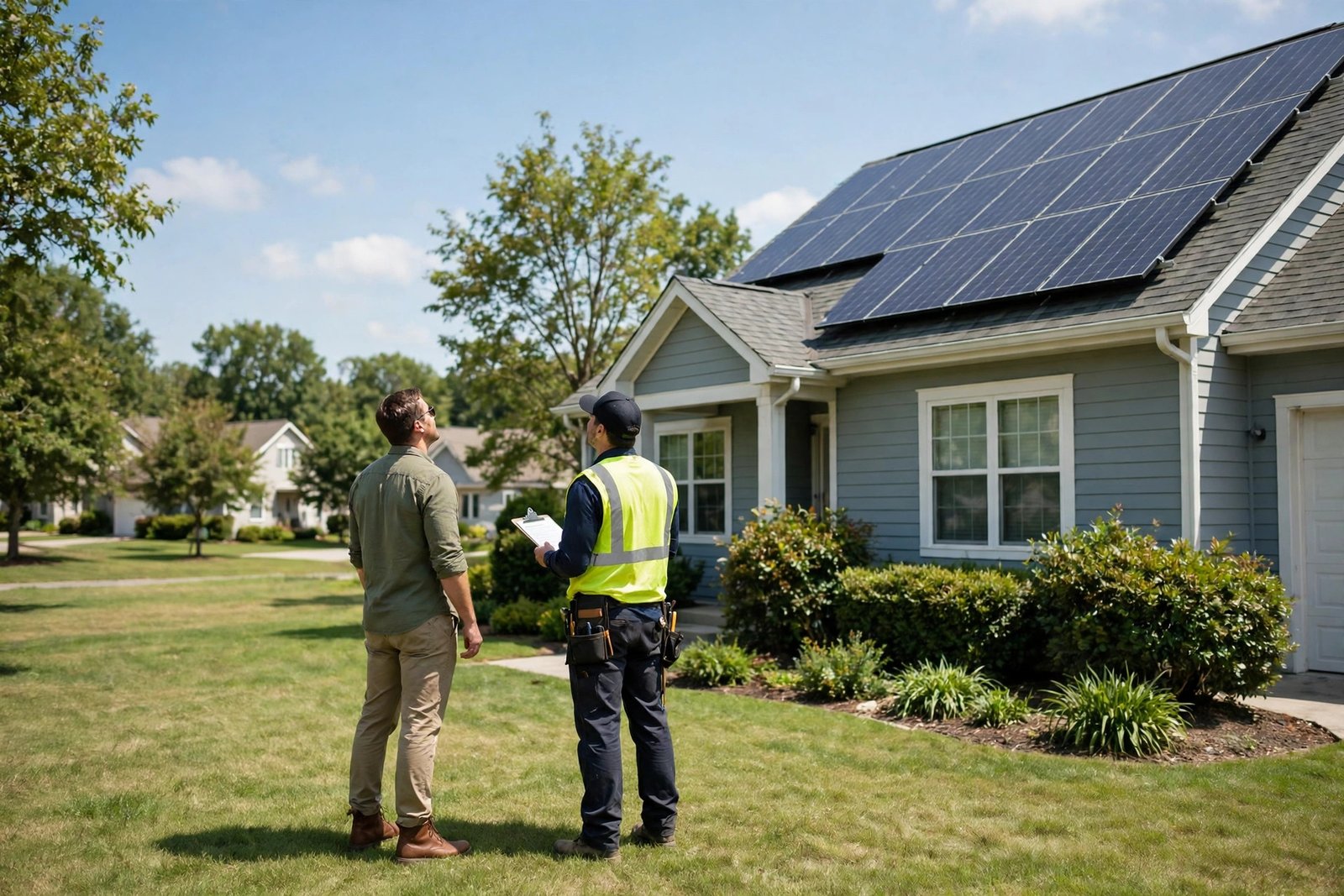
This is the first question, and the most important. A solar repair technician works with high-voltage DC electricity and on your roof. If something goes wrong — an injury, a fire, or damage to your home — you need to know the person is properly covered.
What to ask
- Are you licensed or certified to work on solar systems in my area? Ask for the licence number and the name of the body that issued it.
- Do you carry public liability insurance, and how much does it cover?
- Are your employees covered by workers’ compensation or equivalent insurance?
- Do you hold any solar-specific certifications, such as manufacturer training for my inverter or panel brand?
What a good answer sounds like
A good technician gives you the licence number without hesitation and can email you a copy of their insurance certificate. They can name the certification body and explain what it covers. In the USA, look for NABCEP certification or a state electrician’s licence; in the UK, look for MCS certification or registration with a competent-person scheme, and an electrician qualified under Part P of the Building Regulations. These names differ by country, but the principle is the same: the person working on your system should be formally qualified to do so, not just experienced.
Warning signs
Be cautious if the technician says a licence is not needed, cannot produce proof of insurance, or says the insurance is “in the post”. Also be wary of anyone who asks you to sign a waiver giving up your right to claim for damage — a properly insured company does not need that.
Safety note: Never let an uninsured person work on your roof or your electrical system. If they are injured on your property and have no cover of their own, the claim can land on your home insurance — or on you personally.
2. How Much Experience Do You Have With My Equipment?
Solar equipment varies enormously between brands. An inverter from one manufacturer has different error codes, menus and common faults from another. A technician who repairs one brand every week will diagnose your problem far faster than someone seeing it for the first time.
What to ask
- Have you repaired my inverter brand and model before? How often?
- Have you fixed this specific fault before — for example, this error code, or this type of panel damage?
- How many years have you been repairing solar systems, as opposed to installing new ones?
- Do you work with battery systems too, if my system has one?
What a good answer sounds like
The technician names your brand, describes a similar repair they have done, and can explain the likely cause in plain language. They are honest about the limits of their experience — “I have not worked on that exact model, but I have repaired the same manufacturer’s range and I can get the manual and parts” is a reasonable answer, as long as they are upfront about it.
Warning signs
Vague claims such as “I can fix anything” without specifics, or a technician who has only ever installed new systems and never repaired an old one. Installation and repair are different skills: repair work means diagnosing a fault in a system someone else built, often years ago.
3. How Will You Diagnose the Problem?
A proper diagnosis comes before a repair, not after. You want to know that the technician will find the real cause, not just replace the most expensive part and hope.
What to ask
- What checks will you do before deciding what needs replacing?
- Will you test the panels, wiring, inverter and connections, or only look at the inverter display?
- Is there a diagnostic or call-out fee, and is it deducted from the repair cost if I go ahead?
- Will you show me the test results or explain what you found?
What a good answer sounds like
The technician describes a logical sequence: check the monitoring data and error history, inspect the inverter and its connections, test string voltages with a multimeter, check isolators and breakers, inspect panels and wiring for visible damage, and only then recommend a repair. They tell you the call-out fee up front and whether it counts towards the repair.
For more detail on what a fault can look like, see our guides on how to fix a solar inverter red light and understanding common solar inverter error codes.
4. What Exactly Will the Repair Involve?
Before agreeing to anything, you need a clear picture of the work: what will be replaced, what will be disturbed, and what will be left as it is.
What to ask
- Exactly which parts will you replace or repair?
- Will you need to remove panels, and if so, how many?
- Will the power need to be switched off, and for how long?
- Will you need access to the loft, the roof, or the inside of the house?
- Will you clean up afterwards and remove old parts?
A written scope of work protects both sides. If the technician later says “that was not included”, the written scope is what you refer back to. Ask for the scope in the quote itself, not just in a conversation.
5. What Will It Cost — in Writing?
Price is where most disputes start, so get it in writing before any work begins. A verbal estimate over the phone is not a quote.
What to ask
- Can you give me an itemised written quote — labour, parts, call-out fee and tax shown separately?
- Is this a fixed price, or could it change once you start work? If it could change, what would trigger that?
- Are there any costs not in the quote, such as scaffolding, skip hire, or a second visit?
- How long is the quote valid for?
For a sense of typical prices, read our solar panel repair cost guide and our guide on how much it costs to replace a broken solar inverter. Prices vary by region and by job, but knowing the usual range helps you spot a quote that is far too high — or suspiciously too low.
Warning signs
A quote that is only a single round number with no breakdown, a price that must be accepted “today only”, or a technician who refuses to put anything in writing. A very low quote can also be a warning: it may mean cheap parts, no warranty, or work that will not be finished properly.

6. Will You Use Genuine Parts?
The parts used in a repair decide how long the fix lasts and whether your manufacturer warranty stays valid. Some repairs can use a generic equivalent; others must use the manufacturer’s own part.
What to ask
- Will you use genuine manufacturer parts, or compatible third-party parts?
- If third-party, why, and will the manufacturer warranty still stand?
- Are the parts new or refurbished? If refurbished, what warranty do they carry?
- How long will parts take to arrive, and will the system be safe while we wait?
Using a non-genuine part is not always wrong — for example, a replacement MC4 connector or a length of cable may be a standard item. But for an inverter board, a battery module or a panel, the wrong part can cause new faults or void the warranty. Ask the technician to explain the choice, and get the part names and model numbers written on the quote.
Read our guide on what voids a solar panel warranty before agreeing to any part substitution, so you know what is at stake.
7. What Warranty Do You Offer on the Repair?
There are two warranties that matter: the warranty on the new part, and the warranty on the technician’s workmanship.
What to ask
- How long is the warranty on the parts you fit, and who provides it — you or the manufacturer?
- How long is your workmanship warranty — your promise that the installation of the repair itself was done properly?
- What exactly does the workmanship warranty cover, and what does it exclude?
- If the same fault comes back within the warranty period, will you return free of charge?
- Will I get the warranty in writing?
A workmanship warranty of at least 12 months is a reasonable expectation for repair work; many reputable companies offer two years or more. A technician who offers no workmanship warranty at all is asking you to take all the risk.
8. How Long Will the Repair Take?
Knowing the timeline helps you plan — especially if the system will be switched off and you are relying on grid electricity in the meantime.
What to ask
- When can you start, and how long will the job take?
- Will the system be off during the repair, and for how long?
- If a part has to be ordered, how long will delivery take, and is the system safe to leave in the meantime?
- What happens if you find a second fault once you start?
A good technician gives you a realistic date, explains any delay honestly, and tells you what to expect if the job turns out to be bigger than first thought. Be wary of anyone who promises a same-day fix for a fault they have not yet inspected — some repairs genuinely are quick, but a promise made before diagnosis is a guess, not a plan.
9. How Do You Work Safely?
Solar panels generate electricity whenever light falls on them, even when the system is switched off at the inverter. Roof work carries fall risks, and DC electricity can arc and cause burns. A professional technician should be able to explain their safety approach without being asked twice.
What to ask
- What safety equipment do you use on the roof — harness, edge protection, scaffolding?
- How do you make the DC side safe before working on it?
- Will you isolate the system properly and test that it is dead before touching wiring?
- Do you follow the manufacturer’s safety instructions for my equipment?
For a sense of what proper safety looks like, see our guide on essential safety gear and tools every DIY solar owner should have.
Safety warning: If a technician suggests working on live DC wiring, bypassing safety isolators, or climbing on your roof without fall protection, stop the job. No repair is worth a serious injury. Solar systems must be isolated and tested dead by a competent person before anyone touches the wiring, and roof work must follow local safety rules.
10. Can You Help With a Warranty Claim?
Many faults turn out to be covered by a manufacturer warranty, which can save you the cost of the part. But claiming a warranty involves paperwork, photos, serial numbers and sometimes a specific process the manufacturer insists on. A technician who has done this before can save you weeks of back-and-forth.
What to ask
- Do you think this fault might be covered by a manufacturer warranty?
- Can you prepare the evidence the manufacturer needs — photos, test readings, serial numbers?
- Will you submit the claim for me, or guide me through it?
- Is there a charge for handling the claim?
For the full process, read our step-by-step guide on how to claim your solar panel warranty, and our explanation of product warranty vs. performance warranty so you know which warranty applies to your fault.
11. What Happens If the Repair Does Not Fix It?
Sometimes a repair does not solve the problem. The fault may have a second cause, or the replacement part may be faulty itself. Agree in advance what happens then.
What to ask
- If the system still does not work after the repair, will you come back and re-diagnose it?
- Will that second visit be charged?
- If a replacement part turns out to be faulty, who pays for the replacement and the extra labour?
- At what point would you recommend replacing the equipment instead of repairing it again?
A technician who stands behind their diagnosis will usually return to re-check their own work at no extra labour cost within a reasonable period. Get that promise in writing with the workmanship warranty, not as a verbal assurance.
12. Can I See Reviews or Speak to Past Customers?
Reviews and references are one of the best ways to judge a technician you have never used before. A company with a long record of satisfied customers will not hide it.
What to ask
- Can you show me reviews on an independent platform, such as Google, Trustpilot, Checkatrade or the Better Business Bureau?
- Can you give me the contact details of two recent customers with a similar repair?
- How long has your company been trading, and under the same name?
What a good answer sounds like
The technician points you to a public review profile with a history of reviews over months or years, and offers references willingly. Be a little suspicious of a company with only a handful of five-star reviews all posted in the same week, or with no online presence at all. When you speak to a reference, ask whether the job was finished on time, whether the final bill matched the quote, and whether the technician came back when asked.
If your original installer has gone out of business and you are starting from scratch, our guide on what to do if your solar installer goes out of business explains how to find a replacement company.

13. How and When Do I Pay?
Payment terms should be agreed before work starts, not discovered afterwards. Most reputable repair companies ask for a deposit for parts, with the balance on completion.
What to ask
- How much do you need up front, and what is it for?
- When is the balance due — on completion, or after I have checked the system is working?
- What payment methods do you accept, and will I get a proper invoice and receipt?
- Is there a charge for a second visit if the first visit only diagnoses the fault?
Warning signs
Never pay the full amount in advance. A request for 100% payment up front, especially in cash with no invoice, is a serious red flag. A reasonable arrangement is a deposit to cover ordered parts, with the rest paid once the repair is complete and the system is shown working. If the technician insists on cash only and no paperwork, walk away.
14. What Happens to My Roof and the Mounting?
Many solar repairs involve the roof: removing panels, tightening clamps, replacing flashing, or re-sealing mounts. Roof work done badly can cause leaks that only appear months later.
What to ask
- Will you disturb the roof covering or the flashing, and how will you re-seal it?
- If panels are removed, will the mounting hardware be checked and re-torqued when they go back?
- Who is responsible if a leak appears after the repair — you, or a roofer?
- Do you use scaffolding or a roof ladder, and is that included in the price?
If the repair involves significant roof work, ask whether a roofer will be involved and whether the roofing work is covered by the same workmanship warranty. After the repair, check the area under the panels from inside the loft after the next heavy rain, and ask the technician to confirm the roof is watertight before they leave.
15. Will You Check the Whole System Afterwards?
A repair is only finished when the whole system is proven to be working — not just the part that was replaced. Ask the technician to confirm the system is producing power normally before they leave.
What to ask
- Will you test the system after the repair and show me the output?
- Will you check the monitoring app is updating and the readings look normal?
- Will you leave me a written record of what was done, the parts fitted, and the readings after the repair?
- Should I watch anything over the next few days, and what should I do if the fault returns?
A written job report is valuable: it records the serial numbers of new parts, the test results, and the date of the repair. Keep it with your other solar paperwork — you will need it if a warranty claim or a future fault arises.
How to Compare Quotes Fairly
Get at least two, ideally three, quotes for any repair that costs more than a small call-out fee. But comparing quotes only works if they cover the same work.
A simple comparison checklist
| Item | Quote A | Quote B | Quote C |
|---|---|---|---|
| Call-out / diagnostic fee | |||
| Parts (named, with model numbers) | |||
| Labour (hours and rate) | |||
| Scaffolding or access costs | |||
| Tax included? | |||
| Parts warranty (length) | |||
| Workmanship warranty (length) | |||
| Time to start / finish | |||
| Payment terms |
If one quote is much cheaper than the others, ask why. It may be a genuine saving — a smaller company with lower overheads — or it may be missing something: no scaffolding, no warranty, refurbished parts, or a diagnosis that has not actually been done. If a quote is much more expensive, ask what extra you are getting for the money. Sometimes the higher price buys a faster start, a longer warranty, or genuine parts where the cheaper quote uses copies.
Do not choose on price alone. A slightly more expensive technician with proper insurance, a written warranty and good reviews is usually cheaper in the long run than a bargain repair that fails within months.
Red Flags: When to Walk Away
Trust your judgement. Any one of these on its own is a reason to pause; two or more together is a reason to find someone else.
- No licence or insurance proof: cannot show a licence number or an insurance certificate.
- Pressure to decide today: “this price is only valid if you agree now” or “I can only come if you book in the next hour”.
- Full payment up front: especially in cash, with no invoice or written contract.
- No written quote: everything verbal, nothing on paper or by email.
- No warranty on the work: the technician will not guarantee their own repair.
- Door-to-door cold calling: turning up uninvited after a storm, offering to inspect your roof for free and finding urgent damage on the spot.
- Asking you to claim on your insurance first: before any diagnosis, or offering to “handle” your insurance claim for a fee.
- Vague about the fault: cannot explain in plain language what is wrong or what they will do about it.
- Bad reviews or none at all: a pattern of complaints about unfinished work, or no traceable trading history.
- Wants you to sign a blank or incomplete form: never sign anything with blank spaces.
If you have already agreed to work and the technician’s behaviour changes — the price rises without explanation, the work is not what was quoted, or safety rules are ignored — you can stop the job. Take photos of the work so far, keep all messages and paperwork, and get a second opinion before letting anyone else continue.
What Good Answers Sound Like
It helps to know what a strong technician sounds like, so here is a quick summary of the answers you want to hear:
- Licence and insurance: “Here is my licence number and a copy of my insurance certificate. I am certified for this work.”
- Experience: “I have repaired your inverter model many times. The usual cause of that error code is X, and I will test for it first.”
- Diagnosis: “I will check the error history, test the string voltages, inspect the connections, and then tell you what needs replacing before I do it.”
- Cost: “Here is an itemised written quote. The price is fixed unless we find a second fault, in which case I will tell you before doing extra work.”
- Warranty: “The part carries the manufacturer’s warranty, and I guarantee my workmanship for two years. If the same fault comes back, I will return free of charge.”
- Payment: “A deposit covers the parts. The balance is due when the system is working and I have shown you the output.”
If the answers you hear sound like these, you have probably found the right person. If they sound like the opposite — evasive, rushed or vague — keep looking. A good repair starts with a good conversation.
When to Call a Professional
The whole point of this guide is hiring a professional — but it is worth stating plainly when that is not optional. Call a qualified solar technician, and do not attempt the work yourself, if:
- The fault involves the inverter, the DC isolator, the consumer unit, or any wiring. DC voltages in a solar system can be several hundred volts and can arc even in daylight.
- You need to go on the roof. Falls from roofs are a leading cause of serious injury in home maintenance.
- An error code or fault keeps returning after a reset, or the system smells of burning, is making unusual noises, or has visible scorch marks. Switch the system off at the AC isolator if it is safe to do so, and call a technician immediately.
- The repair could affect a manufacturer warranty or an insurance claim. A professional repair with proper documentation protects both.
Simple homeowner checks — reading the inverter display, checking the monitoring app, noting error codes, and looking for visible damage from the ground — are safe and useful. Anything beyond that belongs to a qualified technician. Our guide on DIY solar repair vs. hiring a pro explains exactly where that line falls.
FAQs
How much should a solar repair technician charge for a call-out?
Call-out and diagnostic fees vary by region, but a typical charge covers the visit and the first hour of diagnosis. Some companies deduct the call-out fee from the repair cost if you go ahead. Always ask the fee before booking, and ask whether it is fixed or hourly.
Should I get more than one quote for a solar repair?
Yes — two or three quotes for anything beyond a small diagnostic visit. Make sure each quote covers the same scope of work, the same parts, and the same warranty, or the comparison will mislead you.
Can any electrician repair a solar system?
Not necessarily. A general electrician understands AC household wiring, but solar systems also involve DC circuits, inverters, optimisers and monitoring equipment that need specialist knowledge. Look for a technician with solar-specific training and experience with your equipment brand.
How do I check if a solar technician is licensed?
Ask for the licence or certification number, then check it with the issuing body — for example, NABCEP or your state licensing board in the USA, or MCS and the relevant competent-person scheme in the UK. A genuine technician will not mind you checking.
What should a solar repair quote include?
An itemised breakdown: labour, parts with model numbers, call-out fee, scaffolding or access costs, tax, the parts warranty, the workmanship warranty, payment terms, and how long the quote is valid for. Anything less is not a proper quote.
Is it safe to pay a deposit before the repair starts?
A deposit to cover ordered parts is normal. Paying the full amount before any work is done is not. The balance should be due once the repair is complete and the system is shown working.
What if the technician finds a second fault during the repair?
A good technician stops, explains the new fault, and gives you a revised price before doing the extra work. They should not carry out unapproved work and add it to the bill afterwards. Agree this in advance when you discuss the quote.
Conclusion
Hiring a solar repair technician is not a decision to rush. The right questions — about licences, insurance, experience, diagnosis, cost, parts, warranty and safety — take only a few minutes to ask, and they protect you from bad repairs, surprise bills and voided warranties. Get your answers in writing, compare two or three itemised quotes, check reviews and references, and never pay in full up front.
The best technicians welcome these questions, because they have nothing to hide. If someone dodges them, pressures you, or cannot show proof of their qualifications, walk away and call someone else. Your solar system is a long-term investment, and it deserves a repair done properly by a person qualified to do it.
Once your repair is complete, keep the job report, the invoice and the warranty paperwork with your other solar documents. And if you are weighing up whether a job is worth doing yourself at all, read our guide on DIY solar repair vs. hiring a pro first — some jobs are safe for a careful homeowner, but the ones in this guide belong to a professional.