
Quick answer: Most solar panel repairs cost between $150 and $600 (£120–£480) for common faults such as a damaged connector, faulty wiring, or a single panel problem. A full inverter replacement is the biggest single repair, typically $1,000–$3,000 (£800–£2,400) including labour, while a single replacement panel usually costs $300–$600 (£240–£480) fitted. Roof leak repairs around mounts run $300–$1,000 (£240–£800). Prices vary with your location, system size, roof access, and whether the part is still under warranty — always get two or three written quotes before agreeing to any work.
Contents
- Why Solar Repair Costs Vary So Much
- Average Repair Costs at a Glance
- Inverter Replacement: The Biggest Repair Bill
- Cracked or Damaged Panel Replacement
- Wiring, Connectors and Junction Boxes
- Mounts, Racking and Roof Leak Repairs
- Cleaning and Routine Maintenance Costs
- Labour vs. Parts: Where the Money Goes
- Repair or Replace? How to Decide
- How Warranty and Insurance Change the Bill
- Getting Quotes Without Overpaying
- Hidden Costs to Watch For
- Safety Warnings
- When to Call a Professional
- FAQs
- Conclusion
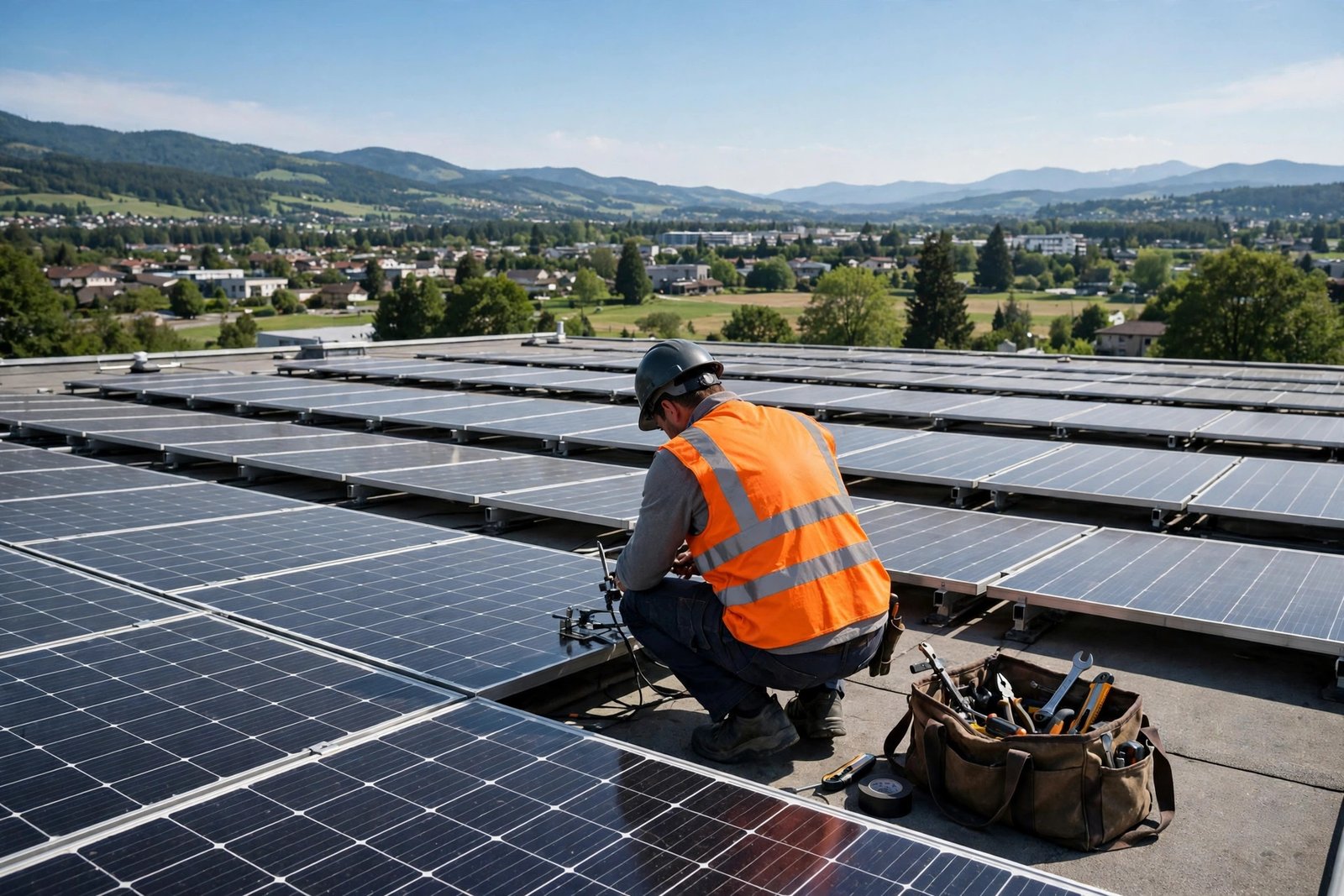
Why Solar Repair Costs Vary So Much
Search for solar repair prices online and you will find a wide range of numbers. That is normal. A repair bill is made of several moving parts, and each one changes the total.
- Location: labour rates are higher in large cities and in the south-east of England than in rural areas. In the US, rates vary by state and by how far the technician must travel.
- Roof access: a single-storey roof with easy access costs less to work on than a steep, three-storey roof that needs scaffolding or a cherry picker.
- System size and age: older systems may use panels or inverters that are no longer made, so a matching replacement costs more — or is not available at all.
- Diagnosis time: some faults take ten minutes to find; intermittent faults can take hours of testing. Many companies charge a call-out or diagnostic fee of $75–$150 (£60–£120), sometimes waived if you go ahead with the repair.
- Warranty status: if the faulty part is under warranty, you may pay only labour — or nothing at all. Always check the warranty before paying for a repair.
The prices in this guide are typical ranges for the US and UK, based on commonly published installer and industry pricing. Treat them as a planning guide, not a quote. Your actual price depends on your system and your area — get written quotes for the real number.
Average Repair Costs at a Glance
This table covers the repairs homeowners ask about most often. Prices include parts and labour unless stated otherwise.
| Repair | Typical cost (US) | Typical cost (UK) |
|---|---|---|
| Diagnostic visit / call-out | $75–$150 | £60–£120 |
| Replace a damaged MC4 connector | $100–$250 | £80–£200 |
| Fix loose or corroded wiring | $150–$400 | £120–£320 |
| Replace a junction box or bypass diode | $200–$500 | £160–£400 |
| Replace one solar panel | $300–$600 | £240–£480 |
| Replace a string inverter | $1,000–$3,000 | £800–£2,400 |
| Replace a microinverter (one unit) | $200–$400 | £160–£320 |
| Repair a roof leak around mounts | $300–$1,000 | £240–£800 |
| Tighten or replace racking and clamps | $200–$600 | £160–£480 |
| Professional panel cleaning (whole system) | $150–$400 | £100–£300 |
| Replace a charge controller | $200–$600 | £160–£480 |
| Remove and reinstall panels (per panel, for roof work) | $100–$250 | £80–£200 |
These are typical ranges. A small job on an easy roof at the low end of the range is common; a complex job on a difficult roof can go above it.
Inverter Replacement: The Biggest Repair Bill
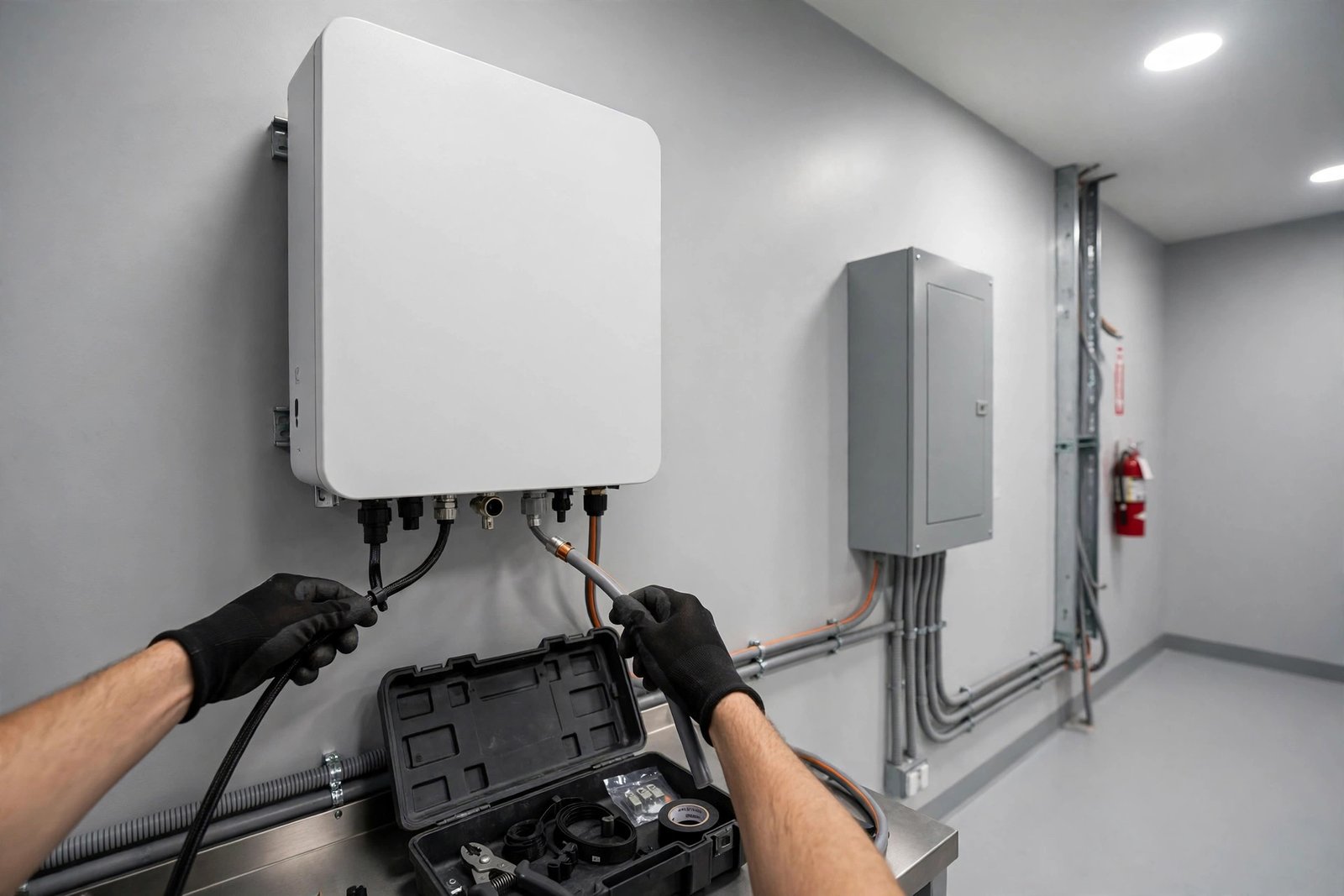
The inverter is the most expensive single component to replace, and it is also the part most likely to fail first. Most string inverters last 10–15 years, while panels last 25 years or more — so many owners replace the inverter at least once during the life of their system.
A like-for-like string inverter replacement typically costs $1,000–$3,000 (£800–£2,400) fitted. The inverter itself is usually $700–$2,000 (£550–£1,600) depending on size and brand, and labour adds $300–$1,000 (£240–£800). Larger systems need bigger, more expensive inverters, and a change of brand may need new wiring or a new mounting bracket.
Microinverters are cheaper per unit — $200–$400 (£160–£320) fitted each — but a system has one per panel, so a fault affecting several units can add up. The good news is that one failed microinverter only takes one panel offline, not the whole system.
Before you agree to a replacement, ask the technician to confirm the diagnosis. An inverter showing a red light or an error code is not always dead — it may be a grid fault, a tripped breaker, or a firmware problem that costs far less to fix. Read our guide to fixing a solar inverter red light before you call anyone out.
Cracked or Damaged Panel Replacement
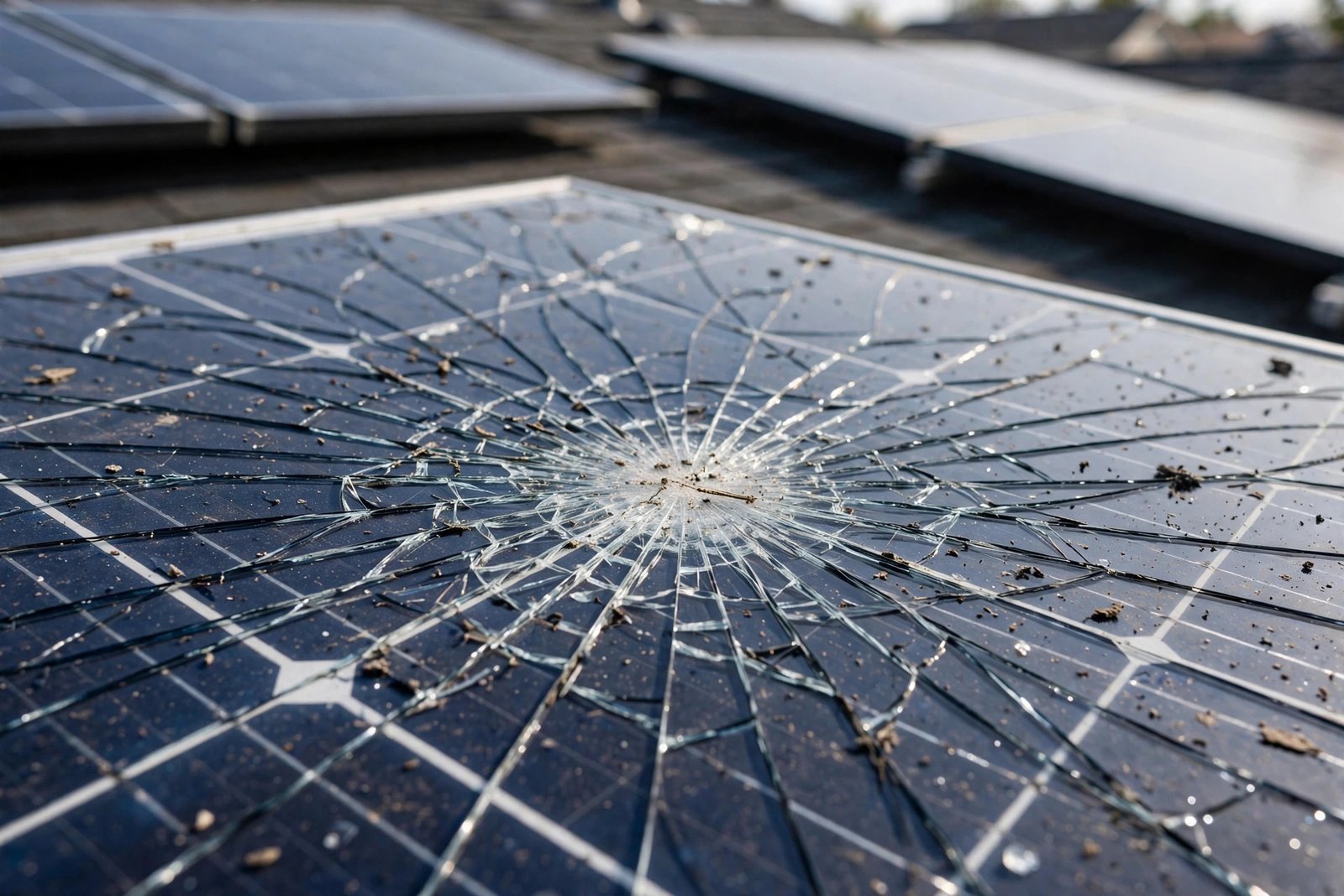
A cracked panel usually needs replacing, not repairing. DIY sealants and tapes can keep water out for a while, but they do not restore the panel’s output or safety, and they can void the warranty. Our guide to repairing a cracked solar panel explains when a temporary fix is acceptable and when replacement is the only sensible option.
Replacing one panel typically costs $300–$600 (£240–£480) fitted, including the panel, labour, and reconnecting it to the string. The panel itself is often $150–$350 (£120–£280); the rest is labour and the cost of working on the roof.
Three things can push the price up:
- Matching the old panel: if your panel model is discontinued, the installer may need to fit a different panel with similar voltage and current. A mismatch can reduce the output of the whole string, so some installers recommend replacing a pair, or fitting a power optimiser.
- Access: panels in the middle of a large array take longer to reach and remove than panels at the edge.
- Age of the system: on systems over 15 years old, a single new panel may perform very differently from its neighbours, and a full-string review may be worth discussing.
If the damage was caused by a storm, falling debris, or vandalism, check your home insurance before paying — storm damage is often covered.
Wiring, Connectors and Junction Boxes
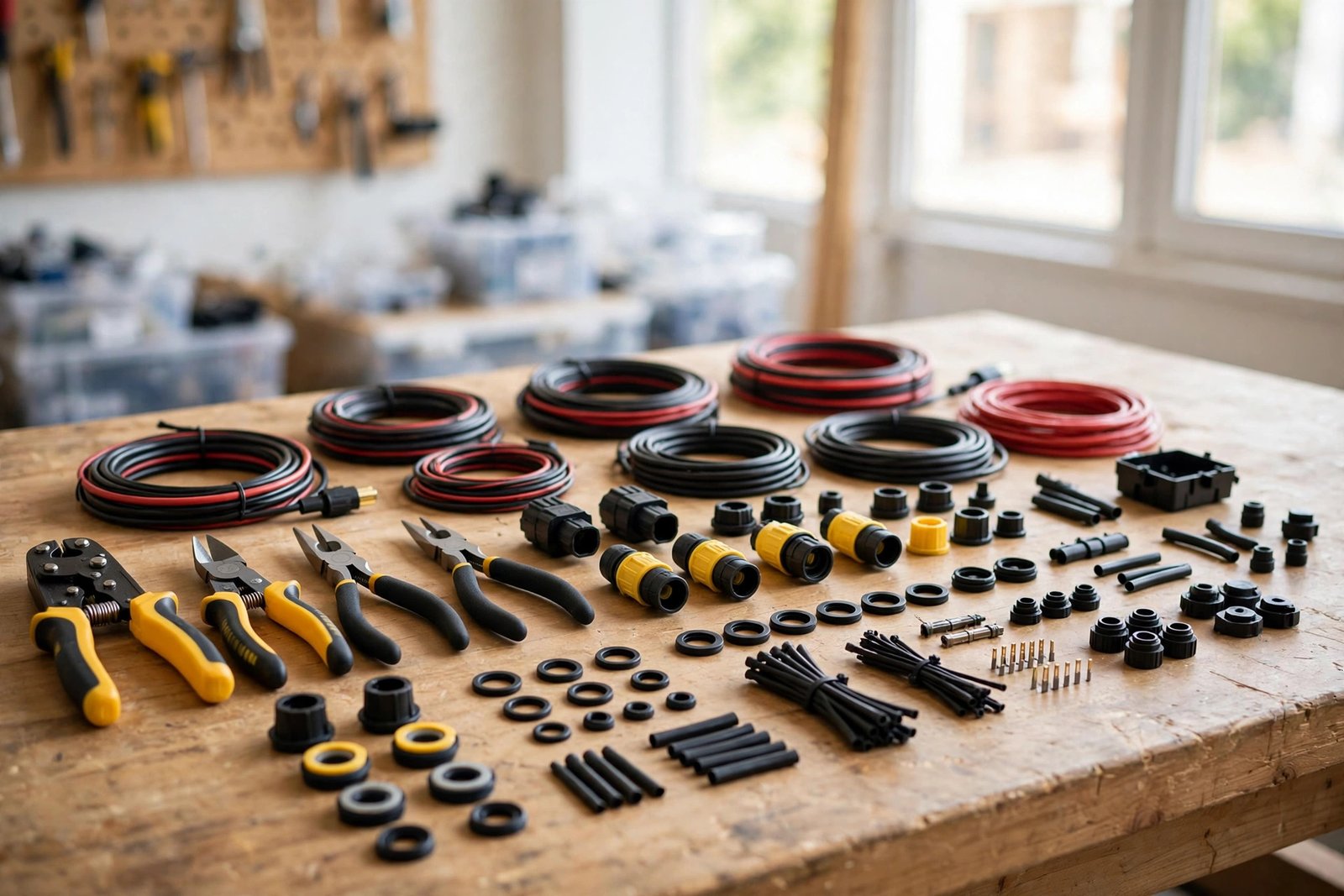
Wiring faults are among the cheapest repairs, and also among the most common. A damaged MC4 connector, a corroded connection, or a chewed cable can shut down a whole string of panels while the panels themselves are perfectly fine.
- MC4 connector replacement: $100–$250 (£80–£200). The part costs very little; most of the bill is the call-out and the time to find the faulty connector. See our step-by-step guide to replacing a damaged MC4 connector safely.
- Loose or corroded wiring: $150–$400 (£120–£320), depending on how much cable must be replaced and how easy it is to reach.
- Junction box or bypass diode: $200–$500 (£160–£400). A failed bypass diode can cause a hotspot and a serious loss of output. Our guide to junction box overheating and burned bypass diodes explains the warning signs.
- Grounding and bonding faults: $200–$500 (£160–£400) for diagnosis and repair, including replacing corroded bonding connections.
Because wiring faults are cheap to fix but expensive to find, a good technician will test the whole string, not just the obvious fault. Ask for the test results in the quote so you know what was actually checked.
Mounts, Racking and Roof Leak Repairs
Mounting hardware is built to last decades, but clamps loosen, bolts corrode, and flashing wears out. A small leak around a mount can cause far more damage — and cost — than the solar repair itself if it is ignored.
- Tightening or replacing clamps and racking: $200–$600 (£160–£480). A full re-torque and inspection of all fixings on a typical residential roof usually falls in this range.
- Roof leak repair around mounts: $300–$1,000 (£240–£800). The range is wide because a simple flashing replacement is cheap, while a leak that has damaged the roof deck or insulation needs a roofer as well as a solar technician. See our guide to fixing a roof leak around solar panel mounts and flashing.
- Removing and reinstalling panels for roof work: $100–$250 (£80–£200) per panel. If your roof needs re-covering, the whole array usually has to come off and go back on — budget $1,500–$4,000 (£1,200–£3,200) for a typical residential system, plus the roofing cost itself.
Roof work and solar work are two trades. If a leak needs both, ask whether the company can do both, or whether you need a separate roofer. A solar company that reseals flashing without checking the roof underneath may only fix the symptom.
Cleaning and Routine Maintenance Costs
Cleaning is the cheapest professional service, and the one most owners can do themselves. A professional clean of a typical residential system costs $150–$400 (£100–£300), depending on system size, roof access, and how dirty the panels are.
An annual inspection usually costs $150–$300 (£120–£240) and covers a visual check of panels, mounts, wiring, and inverter readings, plus a check of the monitoring data. Some installers offer an annual service plan that combines cleaning and inspection for $200–$500 (£160–£400) a year.
For many owners, cleaning is a safe DIY job with a soft brush, water, and a hose — no pressure washer, no harsh chemicals, and never while standing on a wet roof. Our guide to cleaning solar panels safely without scratching the glass covers the method step by step. If your roof is steep, high, or slippery, pay a professional instead.
Labour vs. Parts: Where the Money Goes
On most solar repairs, labour is the larger share of the bill — often 50–70%. That surprises owners who look up the price of a part online and expect the total to match. The part is only one element of the cost.
- Call-out and diagnosis: $75–$150 (£60–£120). Finding the fault can take longer than fixing it, especially with intermittent problems.
- Labour rate: typically $75–$150 (£60–£120) per hour for a qualified solar technician, higher in expensive cities.
- Roof access: scaffolding, a ladder, or a cherry picker adds $100–$500 (£80–£400) to the job when it is needed.
- Parts: connectors and cables are cheap; inverters, panels, and charge controllers are not.
- Testing and sign-off: a proper repair includes re-testing the string and checking the monitoring data — not just swapping the part and leaving.
This is why a $10 connector can come with a $200 bill. You are paying for safe roof access, fault-finding, the right tools, and a tested repair — not just the part.
Repair or Replace? How to Decide
The hardest question in solar repair is not what it costs, but whether the money is worth spending. Use these rules of thumb:
- Repair it if the system is under 10 years old, the fault is a single component, and the repair costs less than about 20% of a new system. A connector, a cable, or a single panel is almost always worth fixing.
- Think carefully if the inverter has failed on a system over 12 years old. A new inverter costs $1,000–$3,000, but panels that old may also be near the end of their efficient life. Get a quote for both repair and a full system replacement before deciding.
- Replace the panel if it is cracked, delaminated, or has a failed junction box that cannot be repaired safely. A damaged panel can be a fire risk and can drag down the output of its whole string.
- Consider a full system replacement if several major parts are failing at once, the system is over 20 years old, or the panels are a discontinued model that cannot be matched. At that point, new panels are more efficient and come with a fresh 25-year warranty.
Always compare the repair cost with the value of the electricity the system still produces. A repair that pays for itself in two or three years of recovered generation is easy to justify. One that takes ten years to pay back, on a system with only a few years of useful life left, usually is not.
How Warranty and Insurance Change the Bill
Before you pay for any repair, check three things. Each one can turn a large bill into a small one — or zero.
- Product warranty: panels are usually covered for 10–12 years against manufacturing defects and 25 years for performance. Inverters are usually covered for 5–12 years. If the failed part is under warranty, the manufacturer should supply a replacement free of charge; you may only pay labour.
- Workmanship warranty: your installer may guarantee their own work for 5–10 years. A leak caused by poor flashing, or a loose mount, may be their responsibility to fix.
- Home insurance: storm damage, falling trees, fire, and vandalism are often covered. File the claim before the repair, and keep photos of the damage — insurers usually want to see the fault before it is fixed.
Keep your original quote, warranty documents, and installation certificate together. Installers and insurers will ask for them, and a missing document can delay a claim by weeks.
Getting Quotes Without Overpaying
A little preparation before you call can save a lot of money.
- Get two or three written quotes. Prices for the same job can vary by 30–50% between companies. A quote should list the part, the labour, and any call-out fee separately.
- Describe the fault clearly. Note the error code, the monitoring readings, and when the problem started. A technician who arrives with the right part saves a second visit.
- Ask what is included. Does the price include testing after the repair? Is the call-out fee waived if you go ahead? Is there a warranty on the repair work itself — usually 12 months is reasonable to expect.
- Be wary of the cheapest quote. A very low price can mean second-hand parts, no testing, or no warranty on the work. A very high price can mean the company is pricing in a full system replacement you do not need.
- Ask about the part. Is it new or refurbished? Is it the same brand and model, or a compatible replacement? A refurbished inverter should cost noticeably less than a new one.
- Do not pay everything up front. A deposit for a large part such as an inverter is normal; full payment before the work is done is not. Pay the balance after the repair is tested and the system is generating again.
Hidden Costs to Watch For
Some costs only appear after the work starts. Ask about them in advance.
- Scaffolding: if the job needs it, confirm who arranges it and whether it is in the quote.
- Second visits: if the technician has to order a part, will the return visit be charged again?
- Monitoring reconnection: after an inverter swap, the monitoring app may need re-setting up. Confirm this is included.
- Disposal: old panels and inverters must be disposed of properly — ask whether disposal is included or charged separately.
- Roof damage found during the job: a technician who lifts a panel and finds rotten decking underneath will need to stop and quote the extra work. Agree in advance how this will be handled.
Safety Warnings
Solar panels produce electricity whenever light falls on them — even on a cloudy day, and even when the inverter is switched off. The DC voltage on a rooftop string can be several hundred volts, enough to cause a serious or fatal shock.
- Never open an inverter, a junction box, or a combiner box while the system is live. Isolate the system first, and follow the manufacturer’s shutdown procedure.
- Never disconnect MC4 connectors under load — this can cause arcing, burns, and damage to the connectors.
- Do not work on a wet, icy, or steep roof. Falls are the most common serious injury in solar work.
- Do not attempt inverter or high-voltage repairs yourself unless you are qualified. These jobs belong to a certified electrician or solar technician.
- If you smell burning, see smoke, or find scorch marks, switch the system off at the isolator and call a professional immediately. Do not try to diagnose it yourself.
When to Call a Professional
Call a qualified solar technician or certified electrician if:
- The inverter needs replacing or shows a fault you cannot clear by following the manufacturer’s reset procedure.
- There is any sign of burning, scorching, melted plastic, or a burning smell.
- A panel is cracked, delaminated, or has a damaged junction box.
- The fault involves wiring, earthing, or anything inside the inverter or combiner box.
- The roof is steep, high, wet, or slippery, or you need scaffolding to reach the array.
- The system is still under warranty — a DIY repair can void it.
- You are unsure what the fault is. A paid diagnosis is cheaper than a wrong repair.
Safe DIY jobs are limited to visual checks from the ground, cleaning reachable panels, checking the monitoring app, and following the manufacturer’s reset procedure. Everything involving live electrics or roof work should be left to a professional.
FAQs
How much does it cost to repair a solar panel?
Most common solar panel repairs cost $150–$600 (£120–£480). A single replacement panel costs $300–$600 (£240–£480) fitted, while small wiring and connector repairs are usually $100–$400 (£80–£320). Inverter replacement is the exception, at $1,000–$3,000 (£800–£2,400).
Is it worth repairing a solar panel or should I replace it?
Repair is usually worth it if the system is under 10 years old and the fault is a single component. Replacement of the panel makes sense when the glass is cracked, the junction box has failed, or the panel is dragging down the whole string. On a system over 20 years old with several failing parts, a full replacement may be better value.
Does home insurance cover solar panel repairs?
Often, yes — for storm damage, falling trees, fire, theft, or vandalism. Wear and tear and age-related failure are not usually covered. Check your policy, take photos before the repair, and file the claim before the work starts.
How much does it cost to replace a solar inverter?
A string inverter replacement typically costs $1,000–$3,000 (£800–£2,400) including parts and labour. A single microinverter costs $200–$400 (£160–£320) fitted. Check the warranty first — many inverters are covered for 10–12 years.
Can I repair solar panels myself to save money?
Only the simplest jobs: cleaning, visual checks, and following the manufacturer’s reset procedure. Anything involving wiring, connectors under load, junction boxes, or roof work should be done by a qualified technician. A DIY repair can also void your warranty, which may cost more than the saving.
How often will my solar system need repairs?
Most well-installed systems need very little repair work. Panels are reliable and rarely fail. The inverter is the part most likely to need replacement once in the system’s life, usually after 10–15 years. An annual inspection and keeping the panels clean will catch most small problems before they become expensive ones.
Conclusion
Solar repair costs are usually smaller than owners fear. Most faults — a connector, a cable, a single panel — cost a few hundred dollars or pounds to fix, and a system that is repaired promptly goes on producing electricity for years. The expensive jobs are inverter replacement and roof work, and both are worth checking against the warranty and your home insurance before you pay.
Get two or three written quotes, ask what is included, and never pay the full amount before the repair is tested. Keep your warranty documents safe, and book an annual inspection — catching a loose connection or a worn seal early is always cheaper than fixing the damage it causes later. A little knowledge about typical prices is the best protection against overpaying, and it is also the fastest way to get your system generating again.
Pingback: How to Claim Your Solar Panel Warranty (Step-by-Step Documentation Guide) - Solar Fixing Guide