
Quick answer: A solar panel product warranty covers defects in materials and workmanship — if a panel fails because it was badly made, the manufacturer repairs or replaces it. A performance warranty is different: it guarantees how much power your panels will still produce after many years, usually promising around 80% or more of the original output after 25 years. Most panels come with both warranties, but they cover different problems, last for different lengths of time, and have different rules. Understanding the difference before something goes wrong can save you thousands.
Table of Contents
- Why Solar Panels Have Two Warranties
- What a Product Warranty Covers
- What a Performance Warranty Covers
- Product vs Performance Warranty at a Glance
- Typical Warranty Lengths
- What Is Not Covered by Either Warranty
- Which Warranty Applies to Your Problem?
- How to Make a Warranty Claim
- How to Keep Your Warranty Valid
- What to Check Before Buying Solar Panels
- When to Call a Professional
- FAQs
- Conclusion
Why Solar Panels Have Two Warranties
When you buy solar panels, you are buying a product that is expected to work outdoors, in sun, rain, wind and snow, for 25 years or more. No other common household purchase comes with that kind of expectation, so manufacturers split their promise into two parts.
The first part is a promise about the panel itself: it was built properly and will not fall apart. The second part is a promise about performance over time: the panel will keep producing a useful amount of electricity as it ages. Both promises matter, but they protect you against completely different risks.
Many homeowners only discover the difference when a problem appears. A panel that stops working after eight years is a product warranty issue. A panel that still works after twenty years but produces far less power than it should is a performance warranty issue. Knowing which one applies decides who pays for the repair, what evidence you need, and how the claim is handled.
This guide explains both warranties in plain language, shows you what manufacturers actually cover, and helps you check whether your own panels are still protected.
What a Product Warranty Covers
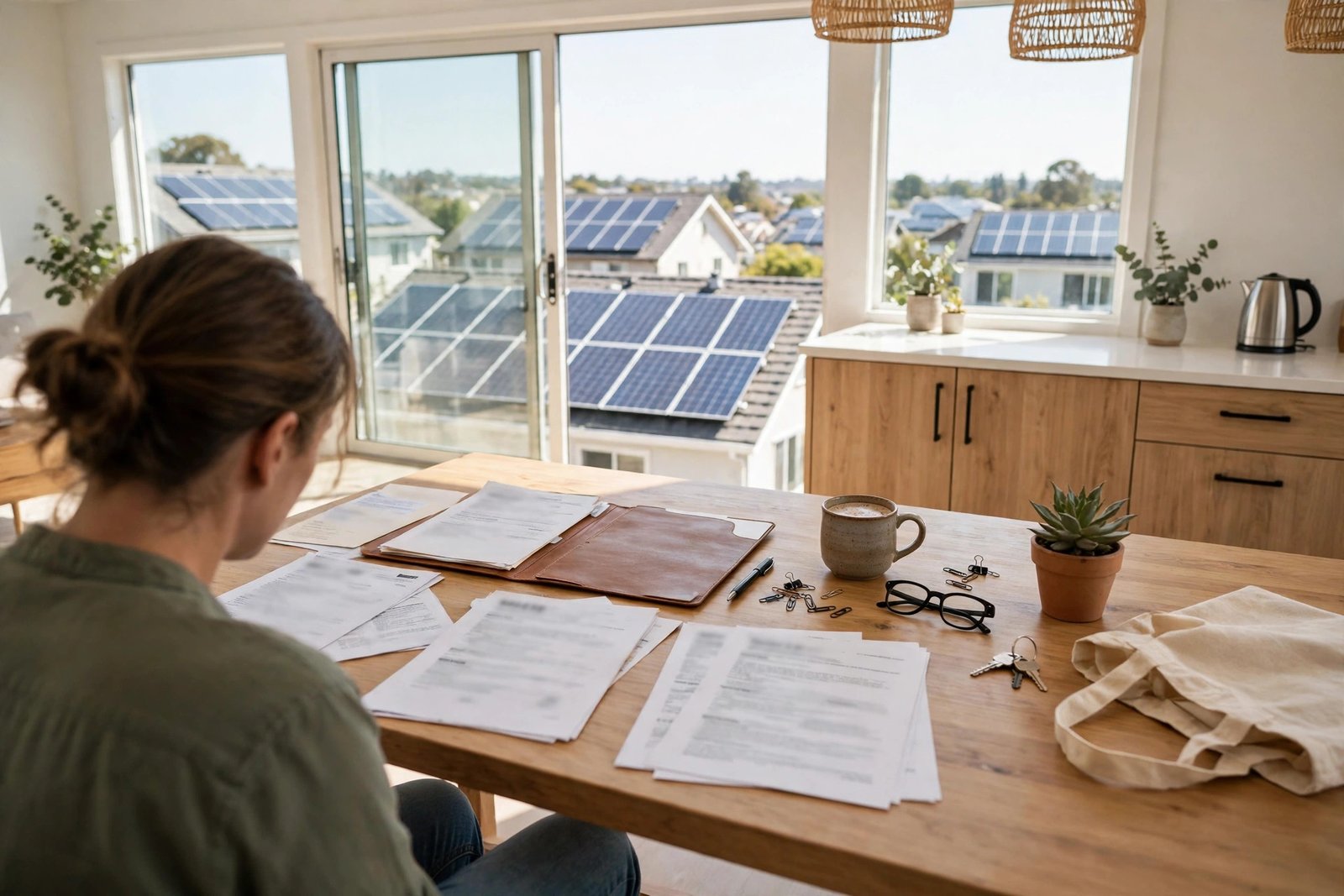
A product warranty — sometimes called a materials and workmanship warranty — covers the physical panel. If something about the way the panel was manufactured or assembled fails during normal use, the manufacturer is responsible.
Problems usually covered by a product warranty
- Manufacturing defects: faulty cells, poor soldering, weak lamination, or a junction box that fails under normal conditions.
- Premature failure: a panel that stops producing power entirely, or a string of panels that goes dead, without any external damage.
- Delamination and yellowing caused by materials: the layers of the panel separating or the encapsulant discolouring because of a material fault — not because of extreme weather or poor installation.
- Frame and glass defects: a frame that corrodes unusually fast, or glass that cracks without any impact, because of a defect in the materials.
- Faulty bypass diodes or junction box components: internal parts that fail during normal operation.
How product warranty claims are usually resolved
When a product warranty claim is accepted, the manufacturer normally repairs the panel, replaces it with the same model, or supplies an equivalent panel if the original model is no longer made. Some manufacturers offer a refund instead. The exact remedy depends on the warranty terms, so read them carefully.
Be aware that a replacement panel may not be identical to your original. If your model has been discontinued, the replacement may have a different appearance or slightly different power rating. Your installer can usually advise whether a different panel will work safely in the same string.
What a product warranty does not do
A product warranty does not promise that your panels will produce a certain amount of power. It also does not cover damage caused by storms, falling objects, animals, poor installation, or unauthorised repairs. Labour costs for removing and reinstalling a panel are often excluded, or covered only for a limited period. Check whether your warranty includes labour, because removal and reinstallation can cost a significant amount on their own.
What a Performance Warranty Covers
Solar panels lose a small amount of output every year. This slow decline is called degradation, and it is normal. A performance warranty — also called a power output warranty or linear performance warranty — guarantees that this decline will stay within agreed limits over the life of the warranty.
How a performance warranty works
A typical performance warranty promises that your panels will still produce a stated percentage of their original rated output after a set number of years. A common structure is a guarantee of around 90% of original output after 10 to 12 years, and around 80% after 25 years. The exact figures vary by manufacturer and model, so always check your own warranty document rather than assuming a standard figure.
Degradation is usually described as a steady annual rate. Many modern panels are rated to lose roughly 0.5% of output per year, though the rate differs between panel types and manufacturers. Your warranty document will state the guaranteed minimum output for each year, or give a straight-line figure.
When a performance warranty claim applies
A performance warranty claim applies when your panels are still working but their output has fallen below the guaranteed level for their age. This is different from a panel that has stopped working altogether — that is a product warranty issue.
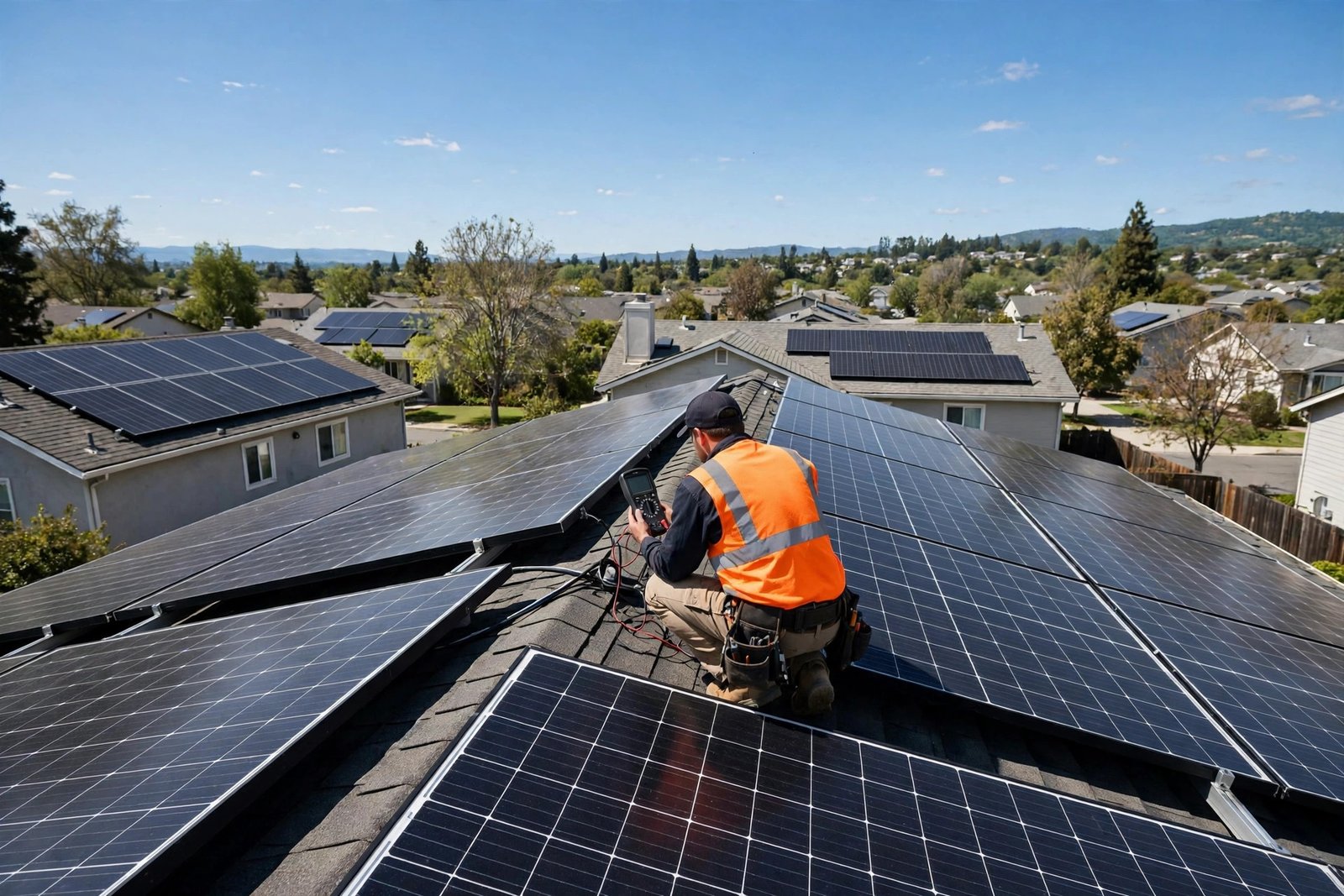
Proving a performance claim usually takes evidence. You will normally need monitoring data showing your system’s output over time, ideally from your inverter or monitoring app, along with the panel’s age and rated capacity. The manufacturer may ask for test results from a qualified technician, or for the panels to be tested under standard conditions. Keep your monitoring records — without them, a performance claim is very hard to prove.
What a performance warranty does not do
A performance warranty does not guarantee a fixed number of kilowatt-hours per year. Your actual production depends on sunlight, shading, temperature, panel angle and soiling, so the warranty is about the panel’s rated capacity, not your electricity bill. It also does not cover a drop in output caused by dirt, shading from a new tree, a faulty inverter, or poor installation. The panel itself must be underperforming for its age.
Product vs Performance Warranty at a Glance
| Feature | Product Warranty | Performance Warranty |
|---|---|---|
| What it promises | The panel is free from manufacturing defects | The panel keeps producing a guaranteed share of its rated power |
| Typical length | 10 to 12 years, some manufacturers now offer 25 years | Usually 25 years, sometimes 30 years |
| Problem it covers | Panel fails, breaks or stops working because of a defect | Panel still works but output falls below the guaranteed level |
| Evidence needed | Photos, inspection report, proof of purchase | Monitoring data, output measurements, panel age and rated capacity |
| Usual remedy | Repair, replacement or refund | Replacement panel, additional panels, or compensation |
| Labour included? | Sometimes, often only for a limited period — check the terms | Rarely; removal and reinstallation are usually your cost |
| Main exclusions | Storm damage, misuse, poor installation, unauthorised repairs | Shading, soiling, inverter faults, damage from external causes |
Typical Warranty Lengths
Warranty lengths have improved steadily as panel quality has improved. Here is what is common in the market today — always confirm the exact figures on your own warranty document, because they vary by brand and model.
Product warranties
- Standard: 10 to 12 years of cover for materials and workmanship.
- Extended: some manufacturers now offer 25-year product warranties, and a small number offer even longer. A longer product warranty is usually a sign that the manufacturer is confident in its build quality.
- Inverters and batteries are separate: your inverter and battery usually have their own, shorter warranties — often 5 to 12 years. Do not assume the panel warranty covers them.
Performance warranties
- Standard: 25 years, with a guaranteed output of around 80% or more at year 25.
- Longer terms: some manufacturers offer 30-year performance warranties with a slightly higher guaranteed output at the end of the term.
- Two-step vs linear: older warranties sometimes guaranteed 90% for the first 10 years and 80% for the remaining 15. Newer linear warranties guarantee a small annual decline instead. Linear warranties are generally more generous in the middle years.
When comparing panels, look at both warranties together. A panel with a 25-year product warranty and a 25-year performance warranty gives you much stronger protection than a panel with a 12-year product warranty and a 25-year performance warranty — because after year 12, a physical failure would no longer be covered, even though the performance promise continues.
What Is Not Covered by Either Warranty
Both warranties have exclusions, and they are broadly similar. Understanding them in advance prevents disappointment when a claim is refused.
Common exclusions
- Storm, hail and flood damage: damage from extreme weather is normally an insurance matter, not a warranty matter. Your homeowners insurance may cover it — check your policy.
- Accidental damage: a falling branch, a ball, or a tradesperson stepping on a panel is not a manufacturing defect.
- Poor installation: if the panels were installed incorrectly — wrong clamps, damaged cables, inadequate flashing — the manufacturer will normally refuse the claim. This is a matter for your installer, who should have their own workmanship warranty.
- Unauthorised repairs or modifications: opening a junction box, replacing parts yourself, or having an unapproved person work on the panels can void the warranty.
- Normal wear and cosmetic changes: slight discolouration of the frame, normal soiling, and the expected annual loss of output are not defects.
- Damage from animals or pests: chewed cables and nesting damage are usually excluded, though some manufacturers cover it — check your terms.
- Failure to maintain: if the warranty requires basic maintenance, such as keeping panels reasonably clean, and you have not done it, a claim may be refused.
Always read the exclusions section of your warranty document. It is usually short, and it tells you exactly where the manufacturer’s responsibility ends.
Which Warranty Applies to Your Problem?
Use this quick guide to work out which warranty is relevant to a problem you have noticed.
- Panel produces no power at all: product warranty — the panel has failed.
- Panel produces power, but much less than expected for its age: performance warranty — but first rule out shading, dirt, inverter faults and wiring problems.
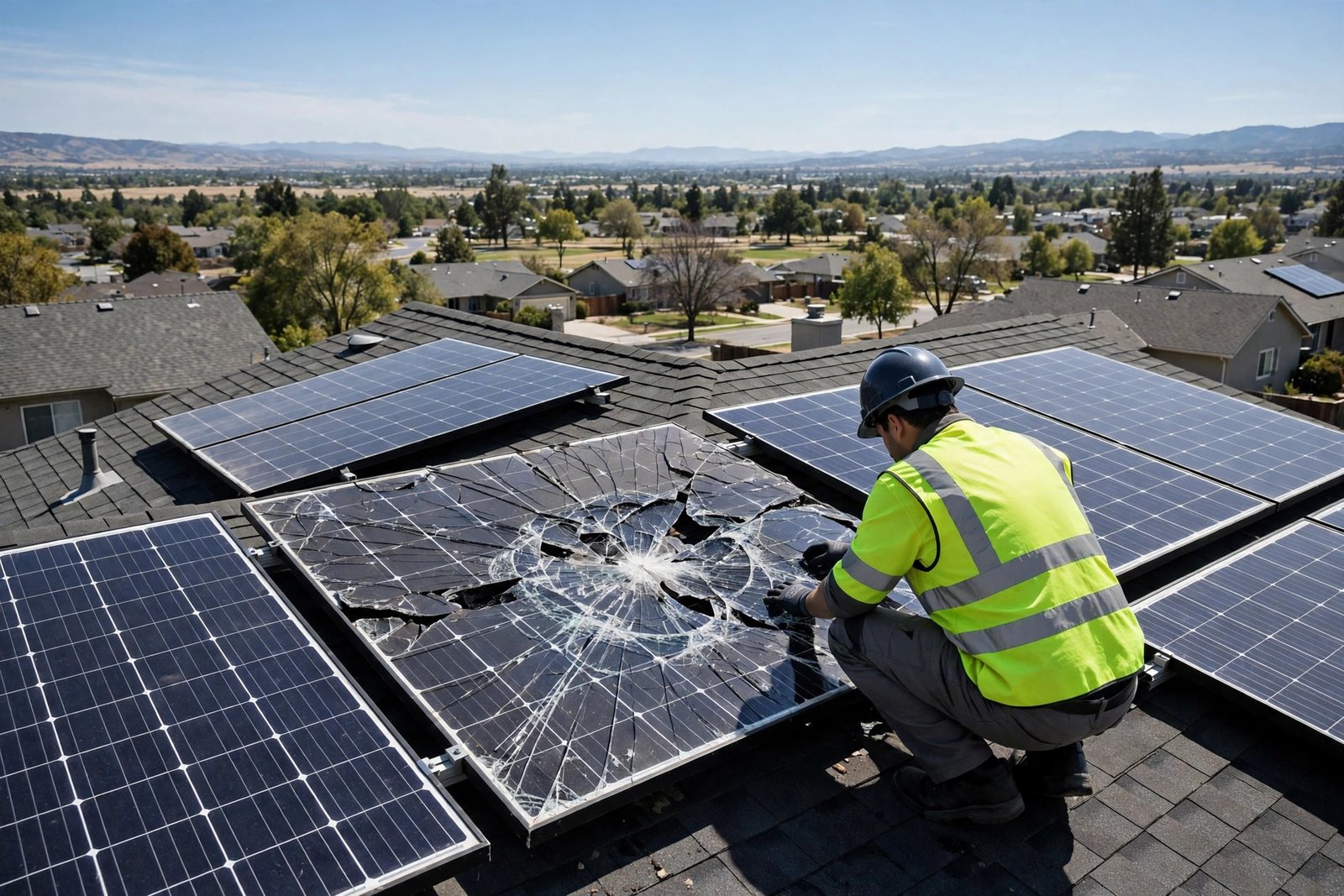
- Visible crack with no impact: product warranty, if the crack is caused by a material or manufacturing fault. If something hit the panel, it is an insurance matter.
- Panel is yellowed or delaminating: product warranty, if the cause is a material defect. A technician’s inspection can confirm the cause.
- Output drops after a storm: check for physical damage first. Storm damage is usually insurance, not warranty — unless the inspection shows a pre-existing defect.
- Inverter shows an error: neither panel warranty applies. The inverter has its own warranty, and the fault may be in the inverter itself.
- Whole system output is low: check the inverter, wiring and monitoring data before blaming the panels. A system-wide drop is often an inverter or connection problem, not a panel problem.
If you are unsure, a qualified solar technician can test individual panels and tell you whether the problem is a defect, a performance issue, or something else entirely. That diagnosis is often the deciding factor in a claim.
How to Make a Warranty Claim
Making a claim is usually a slow process, so start early and keep good records. The full step-by-step process is covered in our companion guide — How to Claim Your Solar Panel Warranty — but here is the short version.
- Gather your documents: proof of purchase or installation contract, the warranty document, panel serial numbers, and the installer’s details.
- Collect evidence: photos of the problem, monitoring data showing output over time, and any error messages from your inverter.
- Contact your installer first: in many cases the installer handles the claim with the manufacturer on your behalf, and they can confirm whether the problem is an installation issue or a panel defect.
- Contact the manufacturer: if the installer cannot help, or is no longer in business, contact the manufacturer’s warranty department directly with your documents and evidence.
- Allow time for assessment: the manufacturer may ask for more data, send a technician, or ask for the panel to be tested. This can take weeks.
- Keep copies of everything: every email, photo and report, in one folder, until the claim is fully resolved.
For performance warranty claims, monitoring data is the most important evidence. If your system does not have monitoring, or the records are incomplete, ask a technician to measure the panels and produce a written report.
How to Keep Your Warranty Valid
A warranty is only useful if it is still valid when you need it. These steps protect your cover.
- Register your panels if required: some manufacturers ask you to register the installation within a set time. Check your warranty document and register promptly.
- Keep your paperwork: store the purchase invoice, installation contract, warranty certificate and serial numbers together, in paper and digital form.
- Use qualified installers for any work: repairs, additions or changes to your system should be done by a qualified solar technician. Unauthorised work can void the warranty.
- Follow the maintenance guidance: keep panels reasonably clean and have the system checked periodically. Our seasonal cleaning schedule is a good starting point.
- Check whether the warranty transfers: if you sell your home, find out whether the warranty passes to the new owner. A transferable warranty can add value to the property. Some manufacturers require a transfer form to be completed within a set time.
- Keep monitoring records: save your output data regularly. It is the evidence you need for a performance claim, and it is also useful for spotting problems early.
- Do not ignore small problems: a small crack, a hot spot or a gradual output drop can get worse. Report problems to your installer early, while the evidence is fresh.
What to Check Before Buying Solar Panels
If you are choosing panels for a new installation, the warranty is one of the most useful ways to compare products. Here is what to look for.
- Product warranty length: prefer 25 years over 10 to 12 years where the price difference is reasonable. A long product warranty signals confidence in build quality.
- Performance guarantee at year 25: compare the guaranteed output percentage, not just the length. A guarantee of 85% or higher at year 25 is stronger than 80%.
- Who backs the warranty: a warranty is only as good as the company behind it. A manufacturer with a long trading history and a presence in your country is more likely to still be there in 20 years.
- Labour and transport costs: ask whether the warranty covers the cost of removing, shipping and reinstalling a faulty panel. If not, budget for those costs yourself.
- Claim process: ask the installer how claims are handled and whether they manage the process for you. A good installer makes claims much easier.
- Installer workmanship warranty: separate from the manufacturer’s warranty, your installer should guarantee their own work — usually for at least 5 to 10 years. This covers installation faults that the panel warranty excludes.
Also consider the cost of repairing or replacing parts that are not covered. Our solar panel repair cost guide and repair vs replace guide can help you weigh the numbers before you buy.
When to Call a Professional
Solar panels operate at high DC voltages, and roof work carries fall risks. Do not attempt to diagnose or repair panel faults yourself.
- Call a qualified solar technician if a panel has stopped producing power, shows visible damage, or its output has dropped sharply. They can test individual panels safely and provide the written report a warranty claim needs.
- Call your installer first if the system is still within the installer’s workmanship warranty period. They may fix the problem free of charge, and they can confirm whether the fault is theirs or the manufacturer’s.
- Call a qualified electrician if you notice burning smells, scorch marks, damaged cables, or anything that suggests an electrical fault. Switch the system off at the inverter if it is safe to do so, and do not touch exposed wiring.
- Contact the manufacturer directly only after you have your documents and evidence ready, or if your installer is no longer in business. See our guide on how to claim your solar panel warranty for the full process.
Safety warning: never climb onto a roof to inspect panels yourself unless you are trained and equipped to work at height. Never open a junction box or touch exposed wiring. Solar panels generate electricity whenever light falls on them, even when the inverter is switched off.
FAQs
What is the difference between a product warranty and a performance warranty?
A product warranty covers manufacturing defects — if a panel fails because it was badly made, the manufacturer repairs or replaces it. A performance warranty guarantees the panel’s power output over time, usually promising around 80% or more of the original output after 25 years. They cover different problems and last for different lengths of time.
How long is a typical solar panel product warranty?
Most product warranties last 10 to 12 years, although some manufacturers now offer 25-year product warranties. Performance warranties are usually 25 years. Always check your own warranty document, because lengths vary by brand and model.
Does a solar panel warranty cover storm damage?
Usually not. Damage from storms, hail, falling objects or flooding is normally an insurance matter, not a warranty matter. Check your homeowners insurance policy — it may cover storm damage to your panels.
What voids a solar panel warranty?
Common causes include unauthorised repairs or modifications, poor installation, using unapproved parts, physical damage, and failing to follow the manufacturer’s maintenance requirements. Always have work done by a qualified technician and keep your records.
Can I transfer my solar panel warranty to a new homeowner?
Many manufacturers allow the warranty to transfer to a new owner, but some require a transfer form to be completed within a set time after the sale. Check your warranty terms before selling your home, and pass the documents to the buyer.
How do I prove a performance warranty claim?
You need monitoring data showing your system’s output over time, along with the panels’ age and rated capacity. The manufacturer may also ask for a technician’s test report. Keep your monitoring records — without them, a performance claim is very difficult to prove.
Does the warranty cover the cost of removing and reinstalling a faulty panel?
Often not, or only for a limited period. Many warranties cover the replacement panel itself but not the labour, transport or scaffolding costs. Check the terms, and see our removal and reinstallation cost guide for typical prices.
Conclusion
A product warranty and a performance warranty are two different promises. The product warranty protects you if a panel is badly made and fails. The performance warranty protects you if a panel slowly loses too much output as it ages. Most panels come with both, but they last for different lengths of time, cover different problems, and need different evidence if you ever claim.
The most important steps are simple: read your warranty document now, before anything goes wrong. Keep your purchase records, serial numbers and monitoring data in one safe place. Use qualified technicians for any work on your system. And if a problem appears, contact your installer early — the sooner a fault is documented, the stronger your claim will be.
For the next steps, read our step-by-step guide to claiming your solar panel warranty, and our guide to whether it is cheaper to repair or replace an old panel if your warranty has already expired.
Pingback: What Voids a Solar Panel Warranty? 7 Mistakes Homeowners Must Avoid - Solar Fixing Guide
Pingback: Does Homeowners Insurance Cover Damaged Solar Panels? How to File a Claim - Solar Fixing Guide