
Quick answer: For a panel under about 10 years old with a single, fixable fault — a cracked junction box, a failed connector, a loose cable — repair is almost always cheaper, usually a few hundred dollars against the cost of a new panel plus labour. For a panel over 15–20 years old, or one that has lost a large share of its output, replacement usually wins: the repair only buys a short extension of life from a panel that is already near the end of it. The deciding question is simple — will the repair cost less than the value of the electricity the panel will still produce before it needs replacing anyway? Work that out before you spend anything, and check your warranty first, because a covered fault may cost you nothing at all.
Contents
- How Old Is “Old” for a Solar Panel?
- The Simple Break-Even Test
- What a Repair Usually Costs
- What a Replacement Usually Costs
- Signs Repair Is the Right Call
- Signs Replacement Is the Smarter Spend
- Check Your Warranty Before You Pay Anything
- Age, Output and the Numbers That Decide It
- Can You Replace Just One Panel?
- Hidden Costs People Forget
- Safety Warnings
- When to Call a Professional
- FAQs
- Conclusion
How Old Is “Old” for a Solar Panel?
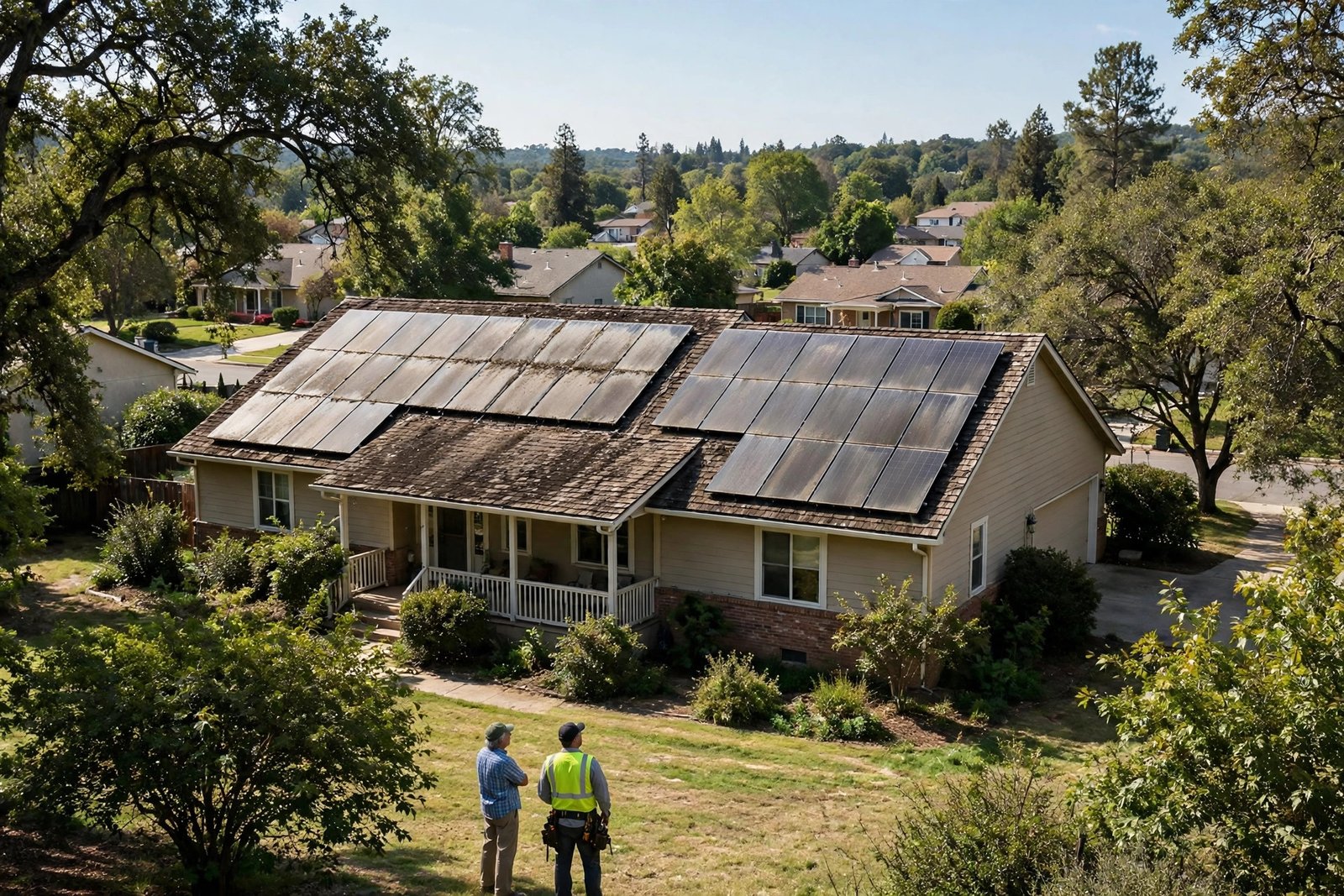
Solar panels do not stop working on a fixed date. They degrade slowly, losing a small percentage of their output every year, and most manufacturers design them to keep producing for 25 years or more. The commonly quoted figure is a loss of roughly 0.5% of output per year, though the real rate varies by panel quality, climate, and how well the system has been maintained. A 15-year-old panel may still be producing around 90% of its original output — perfectly usable. A 25-year-old panel may be down to 80% or less, and at that point the question is not whether it works, but whether it is worth keeping.
Age alone is a poor reason to replace a panel. What matters is the combination of age, output, and condition. A 20-year-old panel in good physical shape that still produces well is a very different case from a 12-year-old panel with cracked glass, a scorched junction box, and a hotspot that keeps tripping the inverter. Before deciding anything, find out how the panel is actually performing. Your monitoring app will show the output of each panel or string over time — our guide to reading your solar monitoring data to spot hidden faults early shows what to look for. If you do not have panel-level monitoring, a technician can test the panel with a multimeter; see our guide on how to test solar panel voltage and amperage with a multimeter.
As a rough guide, think of it in three bands:
- Under 10 years old: the panel has most of its working life ahead of it. Repair is usually the right answer unless the damage is severe.
- 10 to 20 years old: the decision depends on the fault and the cost. A cheap repair on a panel that still produces well is good value; an expensive repair is harder to justify.
- Over 20 years old: the panel is near or past its expected service life. Replacement starts to make sense, especially if output has fallen noticeably or more than one fault has appeared.
The Simple Break-Even Test
You do not need a spreadsheet to make this decision. You need three numbers: the cost of the repair, the cost of the replacement, and a rough idea of how much longer the repaired panel will last.
Ask yourself these four questions:
- How much will the repair cost? Get a written quote, including labour and any parts.
- How much will a replacement cost? Include the new panel, labour, and any removal or disposal fee for the old one.
- How many more useful years will the repaired panel give me? A repair on a 6-year-old panel may buy 15 more years. The same repair on a 22-year-old panel may buy only 2 or 3.
- Is the panel still under warranty? If it is, the repair or replacement may be free — which changes the maths completely.
Then apply the rule of thumb: if the repair costs more than about half the price of a replacement, and the panel is over 15 years old, replace it. If the repair costs less than a third of a replacement and the panel is under 15, repair it. Between those two points, the deciding factors are output and condition — a panel that has lost a lot of output is a weaker candidate for repair than one still performing close to its original rating.
A worked example helps. Suppose a replacement panel, fitted, costs $800. A repair is quoted at $250. The panel is 8 years old and still producing well. The repair costs less than a third of the replacement and buys perhaps 15 more years of service — repair it. Now suppose the same repair is quoted at $450, the panel is 21 years old, and its output has dropped by a quarter. The repair is more than half the replacement cost and buys only a few more years — replace it.
What a Repair Usually Costs
Repair costs vary widely by fault, location, and how easy the roof is to access. The figures below are typical ranges for the US and UK, based on commonly published installer pricing, and include parts and labour unless stated otherwise. Treat them as a planning guide, not a quote — always get a written price for your own system.
| Repair | Typical cost (US) | Typical cost (UK) |
|---|---|---|
| Replace a damaged MC4 connector | $100–$250 | £80–£200 |
| Fix loose or corroded wiring | $150–$400 | £120–£320 |
| Replace a junction box or bypass diode | $200–$500 | £160–£400 |
| Reseal or repair a frame / edge seal | $150–$350 | £120–£280 |
| Replace a cracked panel (new panel + labour) | $400–$1,000+ | £320–£800+ |
| Call-out and diagnosis only | $100–$200 | £80–£160 |
Notice the pattern: most genuine repairs are small jobs. A connector, a cable, or a junction box costs a few hundred dollars at most. The expensive end of repair work is when the panel itself has to come off the roof — removing and refitting a panel adds labour, and our guide to solar panel removal and reinstallation costs for roof repairs explains why that work is priced as a separate job. For a full breakdown of common fixes, see our solar panel repair cost guide.
What a Replacement Usually Costs
Replacing a single panel is not the same as buying a panel off the shelf. The price includes the new panel, removal and disposal of the old one, fitting, reconnection, and testing. Typical ranges:
| Item | Typical cost (US) | Typical cost (UK) |
|---|---|---|
| New residential panel (400W class) | $250–$500 | £200–£400 |
| Removal and disposal of the old panel | $100–$250 | £80–£200 |
| Labour to fit and reconnect | $150–$350 | £120–£280 |
| Total for one panel replaced | $500–$1,100 | £400–£880 |
Two things push the total up. First, matching: if your old panels are no longer made, the installer may need a panel with the same voltage and current characteristics, which can cost more than a standard new panel — or may not be available at all. Second, access: a steep, high, or awkward roof adds labour time. If several panels need replacing, the per-panel cost usually falls, because the call-out, scaffolding, and testing are shared across the job. If the whole array is old and underperforming, replacing the full system is a different decision again — and one where a fresh quote for a complete new system, rather than panel-by-panel replacement, is the honest comparison.
Signs Repair Is the Right Call
Repair is usually the better choice when most of these are true:
- The panel is under 15 years old and has years of useful life left.
- The fault is localised: a failed connector, a loose cable, a junction box fault, or a small area of damage — not a problem spread across the whole panel.
- Output is still close to normal. If the panel produces within roughly 10–15% of its expected output, the cells themselves are probably fine.
- The repair is cheap relative to a replacement — roughly a third of the replacement cost or less.
- It is the first fault. A panel that has never given trouble is a better repair candidate than one that has already been fixed twice.
- The rest of the system is healthy. The inverter, wiring, and other panels are in good shape, so fixing this one panel restores the system properly.
Some faults are almost always worth repairing. A damaged MC4 connector, corroded wiring, or a failed bypass diode are component faults — the panel’s cells are fine, and replacing the failed part restores full performance. Our guides to replacing a damaged MC4 solar connector and fixing loose or corroded solar wiring explain what those jobs involve.
Signs Replacement Is the Smarter Spend
Replacement is usually the better choice when several of these apply:
- The panel is over 20 years old and near the end of its expected service life.
- Output has fallen a lot. If a panel produces 25–30% less than it should, its cells are degrading — no repair restores that.
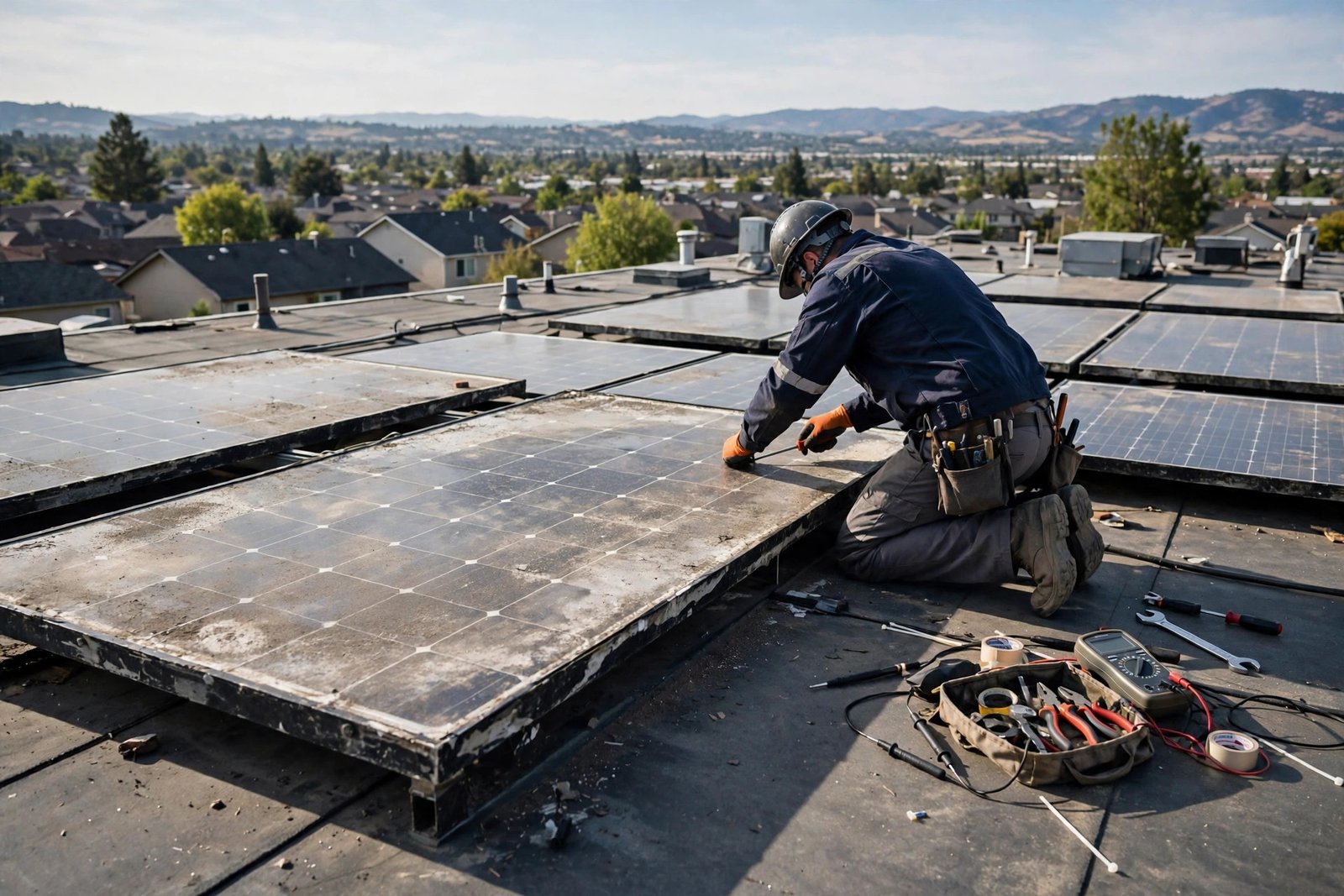
- The glass is cracked or the panel is delaminating. Cracked glass lets moisture in, and delamination — the layers separating and yellowing — is a sign the panel’s structure is failing. See our guides on repairing a cracked solar panel and solar panel delamination and yellowing.
- Hotspots keep appearing. A hotspot is a cell running far hotter than the rest, which damages the panel and can be a fire risk. Repeated hotspots mean the panel itself is failing. See our guide on solar panel hotspots and how to prevent permanent damage.
- Snail trails and microcracks are widespread. A few hairline cracks may be harmless, but widespread microcracks steadily cut output and will not improve. See our guide on snail trails and microcracks.
- The repair costs more than half the price of a new panel. At that point you are paying most of a replacement’s price for a fraction of a replacement’s life.
- It is the second or third repair on the same panel. Repeat faults are a sign the panel is wearing out, not a sign of bad luck.
There is also a practical point: a new panel is more efficient than one made 15 or 20 years ago. A modern panel of the same physical size produces more power, so a replacement can raise the output of that part of your roof — not just restore it.
Check Your Warranty Before You Pay Anything
This is the step most homeowners skip, and it can save the entire cost of the job. Solar panels usually carry two warranties:
- Product warranty — typically 10 to 12 years, sometimes 25, covering manufacturing defects such as a failed junction box, delamination, or a faulty frame. If the fault is a defect, the manufacturer should repair or replace the panel free of charge.
- Performance warranty — typically 25 years, guaranteeing the panel will still produce a stated percentage of its original output (commonly around 80–90%) after 25 years. If output has fallen below the guaranteed level, you may have a claim even if nothing is visibly broken.
Before you accept any quote, check the panel’s make, model, and installation date, then check the warranty terms. Keep the installer’s paperwork, the original invoice, and any photos of the fault. A warranty claim usually needs evidence: monitoring data showing the output drop, photos of the damage, and the panel’s serial number. Do not let anyone start work — or throw the old panel away — before the manufacturer has had a chance to inspect it, or the claim may be refused.
Also check whether your installer is still in business and whether the warranty is backed by the manufacturer rather than the installer alone. If the manufacturer is still trading, a claim can usually proceed even if the original installer has closed. Labour is often not covered by the product warranty, so ask the manufacturer or your installer exactly what is included before work starts.
Age, Output and the Numbers That Decide It
If you want a firmer basis than a gut feeling, work through this short example with your own figures. It uses round numbers — replace them with your quotes and your monitoring data.
Example: a 14-year-old panel, one string of a 4 kW system.
- Repair quote: $300 (new junction box and wiring fix).
- Replacement quote: $850 (panel, removal, fitting, testing).
- Panel output: down about 10% from new — still reasonable.
- Expected remaining life if repaired: roughly 10 more years.
Here the repair is about a third of the replacement cost, and it buys around a decade of service from a panel that still works well. Repair is the clear choice. Now change two numbers: the panel is 23 years old, and its output is down 30%. The same $300 repair buys perhaps 2 or 3 more years before something else fails. The $850 replacement buys a new panel with a fresh 25-year performance warranty and higher efficiency. Replacement is the clear choice.
The middle ground is where most real decisions sit — a 15-year-old panel, a $400 repair, output down 15%. In that case, ask two more questions. First, is the rest of the array the same age? If every panel is 15 years old and this one has failed, others may follow soon, and replacing panels one at a time can end up costing more than a planned, phased replacement. Second, is the roof itself due for work? If the roof will need replacing in the next few years, the panels will have to come off anyway — our guide to removal and reinstallation costs shows what that adds — so timing a replacement with the roofing work can save a second round of labour.
Can You Replace Just One Panel?
Yes, in most cases — but there are three things to get right.
Matching. Panels in a string work together, and the string’s output is limited by its weakest panel. A new panel must be electrically compatible with the old ones — similar voltage and current ratings. If your exact model is no longer made, your installer should find the closest match and check the string’s performance after fitting. A badly matched panel can drag down the whole string.
Inverter compatibility. Most modern inverters accept a range of panel types, but older inverters can be picky. If your inverter is also old, replacing one panel is a good moment to ask whether the inverter itself is near the end of its life. If it is, our guide to the cost of replacing a broken solar inverter will help you price that decision too.
Appearance. A new panel will look different from weathered neighbours — different frame colour, different cell pattern. That is cosmetic and does not affect performance, but it is worth knowing before the work starts, especially if the panel is on the front of the house.
If several panels in the same string need replacing, or if a matching panel cannot be found, replacing the whole string — or the whole array — may be cheaper and simpler than mixing old and new panels.
Hidden Costs People Forget
Both repair and replacement quotes can leave out costs that appear later. Check for these before you agree to anything:
- Call-out and diagnosis: some installers charge separately for the inspection, then deduct it if you go ahead with the work. Ask upfront.
- Scaffolding or access equipment: a steep or high roof may need scaffolding, which can add several hundred dollars to the job.
- Disposal: old panels cannot go in general waste. A responsible installer includes recycling or disposal in the quote — ask, and get it in writing.
- Permits and inspection: some areas require a permit or an inspection when a panel is replaced, particularly if the electrical work changes. Your installer should handle this, but confirm who pays.
- System downtime: while a panel is off the roof, that string produces nothing. A job that drags on for days in summer costs real generation — ask for a firm schedule.
- Recommissioning and testing: after any repair or replacement, the system should be tested and the monitoring checked. Make sure that is included, not charged as an extra visit.
Safety Warnings
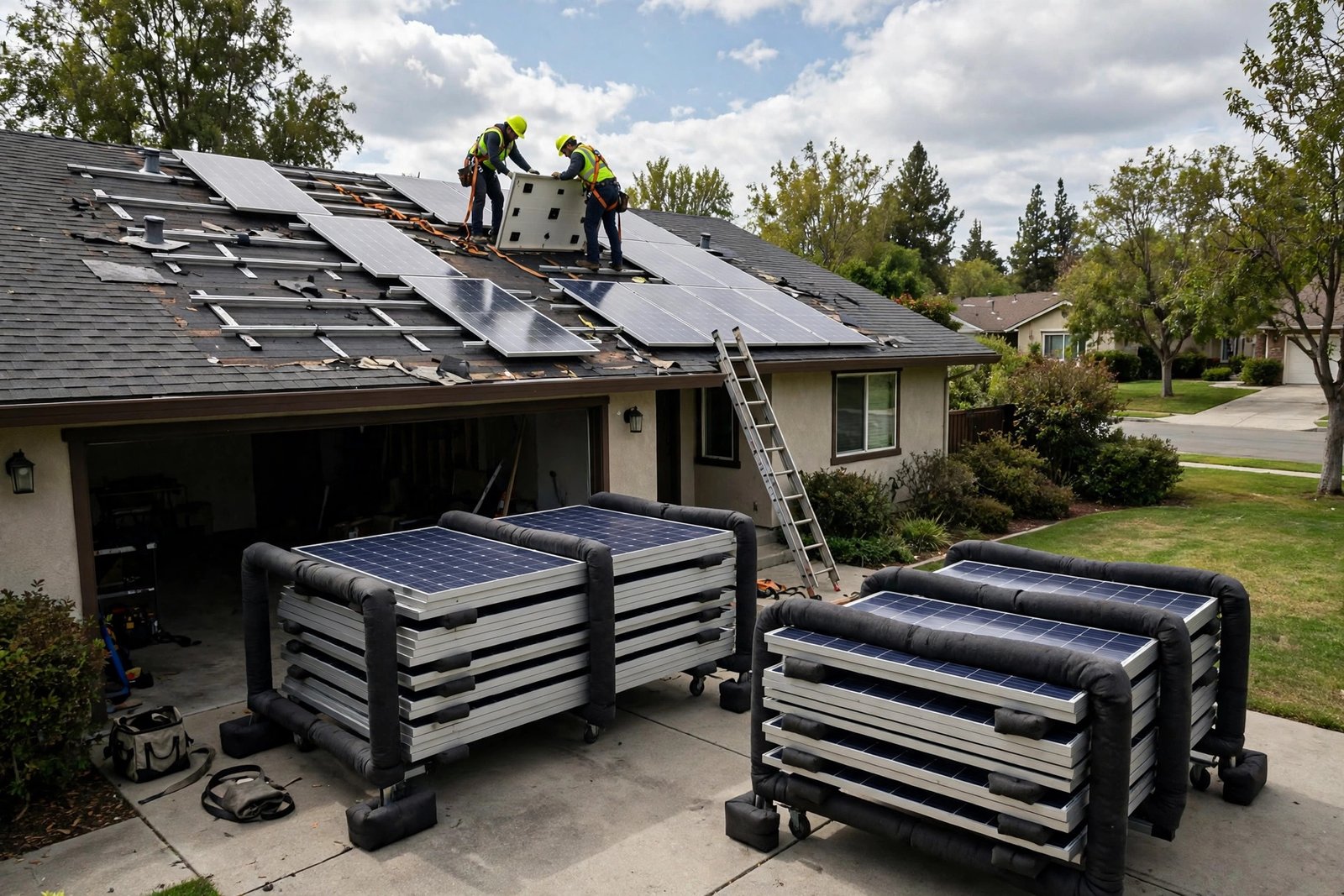
Solar panels generate DC voltage whenever light falls on them — even on a cloudy day, and even when the inverter is switched off. Never touch exposed wiring, open a junction box, or climb onto a roof to inspect a panel yourself unless you are trained and equipped to do so. A cracked panel can still be live, and damaged glass can expose live conductors.
Roof work is dangerous without proper access equipment and fall protection. Do not climb a ladder to “have a quick look” at a suspect panel. Use binoculars from the ground, check your monitoring app, and let a qualified technician do the roof work. If a panel smells of burning, shows scorch marks, or the inverter is showing a fault, switch the system off at the isolator if you can do so safely from the ground, and call a professional — do not touch the panel.
When to Call a Professional
Call a qualified solar technician or electrician if any of the following apply:
- The panel is cracked, scorched, delaminating, or has a visible hotspot.
- The inverter shows a fault code, or the system has stopped producing.
- The fault involves wiring, the junction box, or anything inside the panel.
- The panel is on a roof that needs ladders, scaffolding, or fall protection to reach.
- You need a proper diagnosis — output testing, insulation testing, or thermal imaging — before deciding repair or replacement.
- A warranty claim is involved, and the manufacturer needs a professional report.
What you can safely do yourself: check the monitoring app, look at the panels from the ground with binoculars, note the age and model of the panel, find your warranty paperwork, and get two or three written quotes. Everything on the roof and everything electrical belongs to a professional. If your system is producing noticeably less power and you are not sure why, our guide to why solar panels stop producing enough power will help you narrow down the cause before the technician arrives.
FAQs
How long do solar panels last?
Most panels are designed to keep producing for 25 years or more, losing roughly 0.5% of output per year. Many keep working well beyond 25 years at reduced output. Age alone is not a reason to replace a panel — condition and output matter more.
Is it worth repairing a 20-year-old solar panel?
Usually not, unless the repair is very cheap and the panel still produces well. At 20 years old, a panel is near the end of its expected life, and the same money is often better spent on a new panel with a fresh warranty and higher efficiency.
Can a single solar panel be replaced without replacing the whole system?
Yes. A single panel can be replaced as long as the new panel is electrically compatible with the rest of the string. If an exact match is no longer available, your installer should find the closest compatible panel and check the string’s performance afterwards.
Will my warranty cover a repair or replacement?
It may. Product warranties (typically 10–12 years, sometimes 25) cover manufacturing defects, and performance warranties (typically 25 years) cover output falling below a guaranteed level. Check your warranty terms and keep the panel’s serial number and monitoring data as evidence.
How much does it cost to replace one solar panel?
Typically $500–$1,100 (£400–£880) including the new panel, removal and disposal of the old one, fitting, and testing. The exact figure depends on the panel, roof access, and whether a matching panel is still available.
Does a repaired solar panel produce as much power as before?
If the fault was in a component — a connector, cable, or junction box — a repair usually restores the panel to its normal output for its age. If the cells themselves are damaged or degraded, a repair will not restore lost output, and replacement is the better option.
Should I replace all my panels if one fails?
Not necessarily. If the rest of the array is healthy and similar in age, replace just the failed panel. But if several panels are the same age and starting to fail, or output has fallen across the whole array, get a quote for a phased or full replacement and compare the total cost.
Conclusion
Repair or replace comes down to three things: the panel’s age, its output, and the cost of each option. A young panel with a small, fixable fault is almost always worth repairing. An old panel with falling output, cracked glass, or repeated faults is almost always worth replacing. Between those extremes, use the break-even test — compare the repair cost against the replacement cost and the years of service the repair will actually buy — and check your warranty before you spend a penny, because a covered fault may cost you nothing.
Get two or three written quotes, make sure removal, disposal, and testing are included, and never let anyone start roof work without proper safety equipment. A good decision here is not the cheapest one today — it is the one that gives you the most years of reliable, safe generation for the money you spend.