
Quick answer: A solar inverter that keeps tripping or shutting down is almost always protecting itself — or your home — from a real problem. The most common causes are overloading (too many appliances running at once), overheating, a weak or low battery, a grid voltage problem, a faulty appliance or a short circuit, and, less often, a failing inverter. Start with the safe checks: note the exact time it trips, what was running, and what the display or warning light shows. Switch off heavy appliances, let the inverter cool down, and check the breakers and battery. If it trips again immediately, trips with a burning smell, or shows an earth-fault warning, switch the system off at the isolator and call a qualified solar technician. Never bypass a breaker, remove a cover, or keep resetting a trip that comes straight back.
Table of Contents
- What “Tripping” Actually Means
- The Most Common Causes
- Overload: Too Much Demand at Once
- Overheating
- Battery Problems
- Grid Voltage and Frequency Problems
- A Faulty Appliance or Short Circuit
- Earth Faults and Insulation Problems
- A Failing Inverter
- How to Diagnose the Problem Step by Step
- Fixes You Can Safely Try Yourself
- What the Lights and Display Are Telling You
- Safety Reminders
- When to Call a Professional
- FAQs
- Conclusion
What “Tripping” Actually Means
When people say their inverter “keeps tripping”, they usually mean one of three things, and it helps to know which one you have. First, the inverter itself shuts down: its display goes dark or shows a fault, the warning light comes on, and it stops converting solar power. Second, a breaker in your consumer unit or a breaker near the inverter flips to the off or middle position — that is the circuit breaker doing its job and cutting power to protect the wiring. Third, the inverter restarts on its own, runs for a while, then shuts down again in a repeating cycle.
All three are protective behaviours. An inverter is designed to shut itself down rather than keep running into a dangerous condition. That is good news: it usually means the safety systems are working. The bad news is that a trip is a symptom, not a diagnosis. The same shutdown can be caused by a dozen different problems, from a kettle and a washing machine running together to a genuine fault in the wiring. Your job is to narrow it down with observation before you touch anything — and to know when to stop and call a professional.
One more thing to note before you start: a single trip after a thunderstorm, a power cut, or a very hot day is often a one-off. A trip that repeats every day, every time you switch something on, or within minutes of every restart is a pattern, and patterns need fixing.
The Most Common Causes
In practice, most repeated tripping comes down to a short list. Work through it in order, starting with the simplest and most common causes first. In our experience helping homeowners, overload and overheating alone account for a large share of cases — and both are usually fixable without a technician.
Overload: Too Much Demand at Once
Every inverter has a maximum power rating — for example, a 3 kW inverter can supply up to 3,000 watts of power at a time. If the appliances running at that moment need more than the inverter can deliver, it will overload and shut down to protect itself. This is the most common cause of tripping on off-grid and hybrid systems, and it also happens on grid-tied systems when the inverter is supplying a backup circuit.
The trap is that loads add up quietly. A washing machine on a hot wash, a kettle, a microwave and a water heater can easily pass the limit together, even though each one on its own is fine. Motor-driven appliances such as fridges, freezers, air conditioners and water pumps also draw a short surge of extra power when they start — sometimes several times their normal running power for a second or two. That surge alone can trip an inverter that was already close to its limit.
Signs of overload: the inverter trips at the same time of day (for example, every morning when the kettle, toaster and washing machine run together), it trips the moment a particular appliance starts, or it runs fine at night and on cloudy days but trips at midday when the house is busy. If that sounds familiar, try running one heavy appliance at a time and see whether the tripping stops. Spreading heavy loads through the day is also one of the simplest ways to get more from your solar system — see our guide on the best times to run heavy appliances on solar power.

Overheating
Inverters generate heat while they work, and they shut down when their internal temperature gets too high. This is most common in summer, in small or poorly ventilated rooms, and where the inverter is mounted in direct sunlight, inside a hot loft, or in a cupboard with no airflow. Dust and cobwebs blocking the vents and a cooling fan that has stopped working make it worse.
Signs of overheating: the inverter trips on hot afternoons but works fine in the morning and evening, the case feels very hot to the touch, the fan is noisy, silent when it should be running, or clogged with dust, or the shutdowns started when the weather turned hot. Let the unit cool down with the power off, clear any dust from the vents with a soft brush (with the system switched off), and make sure nothing is stored against it or blocking airflow around it. If the fan has failed, that is a repair job for a technician — do not open the case yourself. For a full guide on keeping an inverter cool, read our article on summer heat and solar efficiency.
Battery Problems
On hybrid and off-grid systems, the battery is the inverter’s power source when the sun is not shining. A battery that is worn out, deeply discharged, or badly maintained cannot hold its voltage up under load. When a heavy appliance switches on, the battery voltage dips sharply, the inverter sees a low-voltage fault, and it shuts down — then restarts once the voltage recovers, and trips again the next time a load appears. This on-off cycle is a classic sign of a battery problem.
Other battery-related causes include a loose or corroded battery terminal (which adds resistance and causes the same voltage dip), a battery bank that is too small for the inverter, and a charge controller or battery setting that is wrong for the battery type. Lead-acid batteries are especially sensitive to this: a battery that has been deeply discharged many times, has low water levels, or has never had an equalization charge can lose capacity long before its expected life ends. If you have lead-acid batteries, our guides on checking battery water levels and equalization charging explain the maintenance that keeps them healthy.
Signs of a battery problem: the inverter trips mostly at night or on cloudy days, the battery voltage on the display drops sharply when a load starts, the battery is several years old, or the system used to run the same loads without any trouble. If you also notice the battery never seems to hold a charge the way it used to, read our guide on using solar power at night without draining your battery to check whether your overnight usage is part of the problem.
Grid Voltage and Frequency Problems
Grid-tied inverters are required by law in most countries to disconnect from the grid if the grid voltage or frequency goes outside a safe range. This is a safety feature: it stops the inverter feeding power into a grid that engineers may be working on. So if your inverter shuts down and your neighbours’ lights flicker too, or the whole street loses power, the inverter is probably behaving correctly — the problem is the grid, not your system.
Grid-related shutdowns are common in areas with weak or unstable supply, at times of high demand, and after storms. The inverter should reconnect by itself once the grid voltage returns to normal, usually after a few minutes. Signs of a grid problem: the inverter trips at the same time as other electrical problems in the house (lights dimming, flickering), the display shows a grid fault or AC over-voltage message, or the shutdowns happen during known power cuts or storms. If the trips only happen when the grid is unstable, contact your electricity supplier and your installer — and do not adjust the inverter’s grid voltage settings yourself, as those settings are set to comply with local regulations.
A Faulty Appliance or Short Circuit
Sometimes the inverter is fine and one of your appliances is not. A faulty appliance with damaged wiring, a failing motor, or water inside it can draw a huge surge of current or create a short circuit. The inverter (or the breaker) trips instantly to protect the rest of the system. This is one of the most important causes to find, because a faulty appliance can also be a fire risk.
The test is simple: if the inverter trips every time you switch on one particular appliance, unplug that appliance and try the system without it. If the tripping stops, you have found your culprit — do not keep using that appliance. Have it repaired or replaced. Common offenders include old water heaters, damaged extension leads, washing machines with worn motors, and any appliance that has been dropped, got wet, or smells of burning. If a breaker trips the instant you plug something in, leave it unplugged and call an electrician.
Earth Faults and Insulation Problems
An earth fault happens when electricity leaks from a wire to earth through a damaged cable, damp wiring, a cracked panel, or a damaged connector. Inverters monitor for this and shut down immediately when they detect it, because a leaking current can be dangerous. Earth faults often appear after heavy rain, in older installations, or where cables have been chewed by rodents or damaged during roof work. Solar panel strings are a common source: a cracked panel or a damaged DC cable lets a small current leak away, especially when the panels are wet.
Signs of an earth fault: the inverter trips mainly on wet or rainy days and works fine when it is dry, the display shows an earth-fault, isolation or insulation warning, or the trips began after roof work or a storm. Earth faults need a qualified technician with proper insulation testing equipment. Do not try to find one yourself — the DC side of a solar system stays live whenever the sun is shining, even with the inverter switched off.
A Failing Inverter
If you have ruled out overload, heat, battery, grid and appliance problems, the inverter itself may be failing. Internal components wear out over time — capacitors age, fans fail, and circuit boards develop faults. Warning signs include tripping that gets more frequent over weeks or months, strange noises, a burning smell, visible damage or swelling, and error messages that keep coming back after a full reset. Age matters: an inverter that is ten or more years old and tripping regularly is often nearing the end of its life.
Before deciding the inverter is finished, check two things that are often overlooked: the firmware and the settings. Some inverters trip because of a known software bug that a firmware update fixes — our guide on how to update solar inverter firmware explains how to check safely. Settings can also drift after a power cut or a battery replacement, so confirm the battery type and voltage settings match your actual battery. If the inverter is still under warranty, contact the manufacturer or your installer before opening anything, as opening the case usually voids the warranty. For an idea of what a replacement involves and costs, see our guide on the cost to replace a broken solar inverter.
How to Diagnose the Problem Step by Step
Work through these steps in order. Write down what you find at each step — the pattern is what a technician will need if you end up calling one.
- Note the pattern. Write down the time of each trip, what was running, the weather, and what the inverter display showed. Do this for two or three trips before changing anything.
- Read the display. Write down the exact message, code or warning light. Take a photo of the display. The manual or the manufacturer’s website explains what each message means — the meaning varies by brand, so do not guess.
- Check the breakers. Look at the breakers in your consumer unit and near the inverter. If one has flipped to the middle or off position, note which one it is. Reset it once, and only once. If it trips again immediately, leave it off.
- Reduce the load. Switch off all heavy appliances. Restart the inverter and let it run with only light loads (lights and a phone charger). If it stays on, add appliances back one at a time, waiting a few minutes between each, until it trips. The last appliance added is your prime suspect.
- Check the battery. On hybrid and off-grid systems, look at the battery voltage on the display before and during a load. A sharp drop when a load starts points to the battery or its connections.
- Check the heat. Feel the inverter case carefully — if it is too hot to touch comfortably, overheating is likely. Note whether the fan is running and whether the vents are clear.
- Check your monitoring app. Most modern systems log faults and show voltage, power and temperature graphs. Look at what happened in the minutes before each trip. Our guide on reading solar monitoring data shows what to look for.
- Look for water and damage. Check around the inverter, the panels and the visible cables for water, burn marks, damaged insulation or loose connections. Do not touch anything that looks burnt or wet — just note it and call a technician.
Fixes You Can Safely Try Yourself
These are the safe, no-tools fixes that solve many cases. Stop at any point if something smells of burning, looks damaged, or trips again immediately.
- Spread out heavy loads. Run the washing machine, dishwasher and water heater at different times instead of together.
- Remove the faulty appliance. If one appliance always causes the trip, unplug it and keep it unplugged.
- Reset once, properly. Switch the inverter off at its isolator, wait a full minute, then switch it back on. A single clean restart clears many temporary faults.
- Clear the airflow. Move stored items away from the inverter, brush dust from the vents with the system off, and shade an inverter that sits in direct sun.
- Check battery terminals. With the system switched off, look for loose or corroded battery terminals. If they are corroded, get them cleaned by a technician — do not work on live battery connections yourself if you are unsure.
- Check the firmware. Look up your inverter model and see whether the manufacturer has released a firmware update that fixes tripping or restart problems.
- Reduce the load at night. If trips happen at night, switch off non-essential loads before bedtime so the battery is not pushed hard when it is already low.
If none of these fixes the problem, or the trips return within a day or two, the fault is beyond simple DIY — see the professional section below.
What the Lights and Display Are Telling You
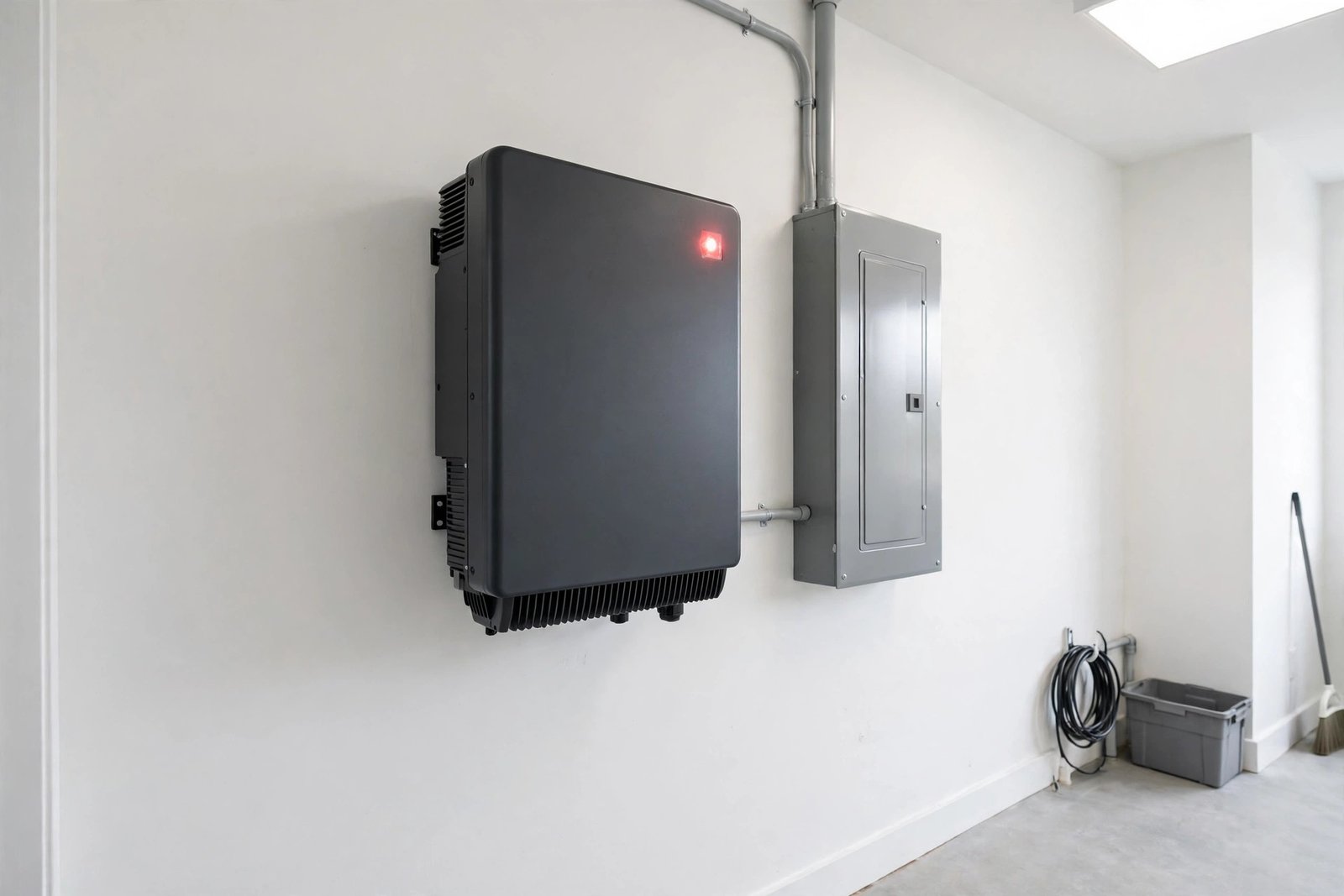
Almost every inverter communicates through a small display, a set of lights, or an app. Learning what yours means saves a lot of guesswork. As a rough guide, a steady green light usually means normal operation, a flashing green light often means the inverter is starting up or waiting for the grid, a red light or a fault message means it has shut down because of a detected problem, and a flashing red or amber light usually means a warning that needs attention but not necessarily a full shutdown.
That said, the exact meanings vary between brands and models — one manufacturer’s flashing amber is another’s grid fault. Never rely on a general guide for your specific unit: check the user manual that came with your inverter, or look up the model on the manufacturer’s website. Write down the exact wording of any message you see. If the manual says the fault requires a technician, believe it.
Safety Reminders
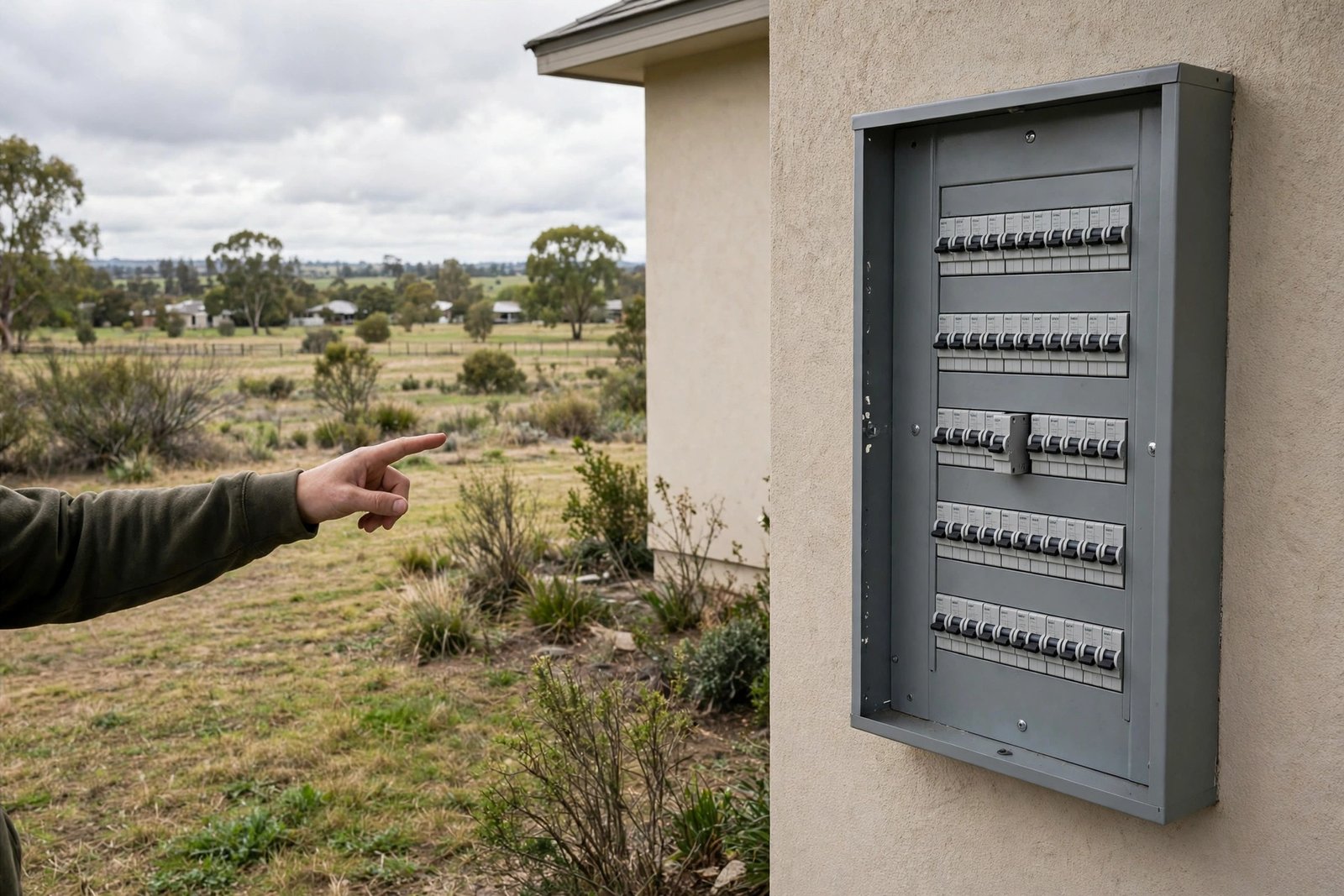
- Never bypass a breaker or a fuse. It tripped for a reason, and bypassing it removes the protection that stops fires.
- Do not open the inverter case. There are live parts inside even when the display is off, and opening it can void your warranty.
- Remember the DC side stays live. Solar panels produce voltage whenever light falls on them, even if the inverter is switched off. Never touch DC cables or connectors.
- Do not work on the system in wet conditions. Water and solar electrics are a dangerous combination.
- Switch off properly. Use the AC isolator and the DC isolator in the order given in your manual, and wait the time the manual says before touching anything.
- Trust your nose and eyes. A burning smell, smoke, scorch marks, melted plastic or buzzing sounds mean switch off at the isolator and call a professional immediately.
- Wear the right gear. If you are doing any visual checks, our guide on essential safety gear and tools for DIY solar owners covers the basics.
When to Call a Professional
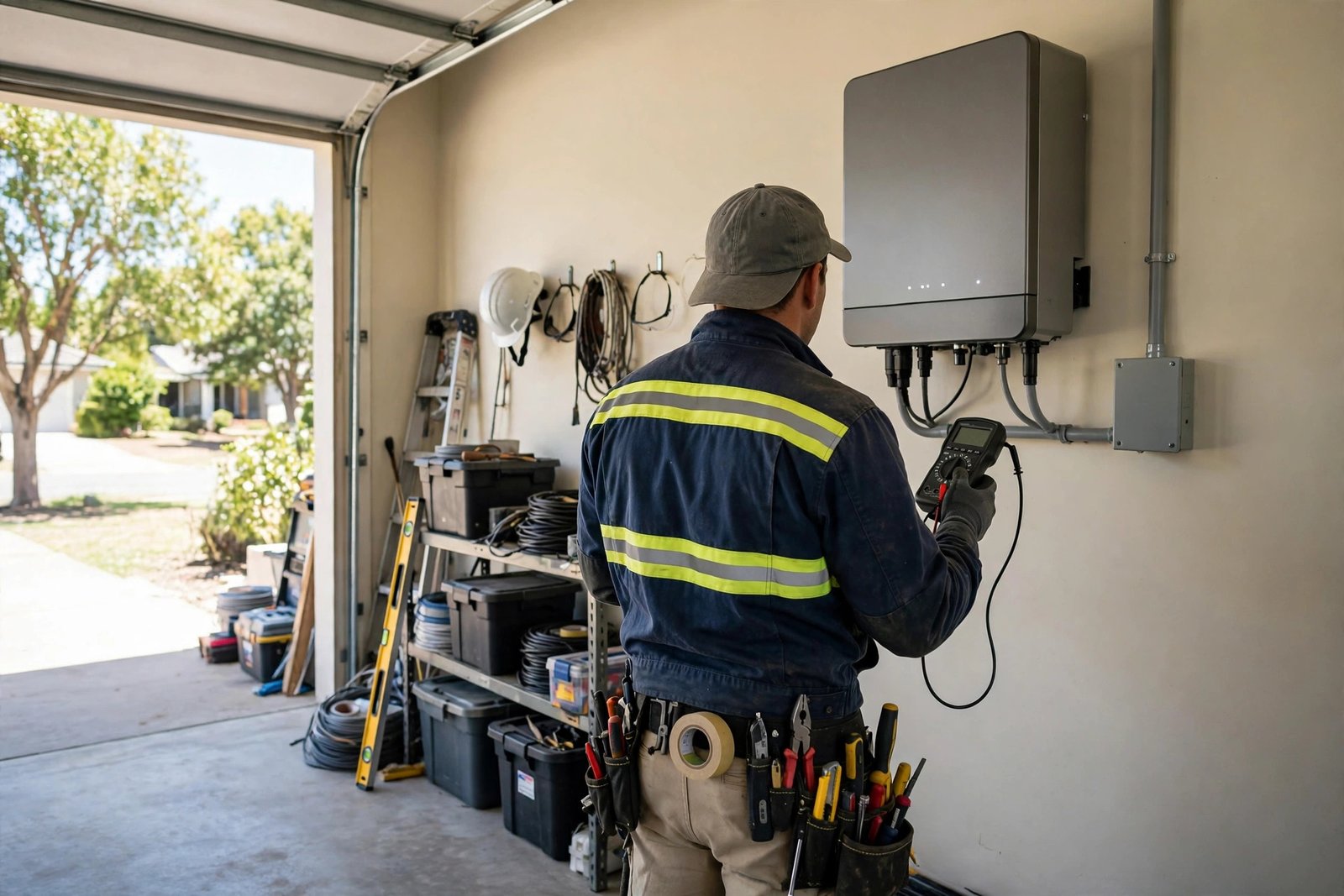
Call a qualified solar technician or electrician if any of the following apply:
- The inverter or breaker trips again immediately after a single reset.
- You smell burning, see smoke, scorch marks or melted parts.
- The display shows an earth-fault, isolation or insulation warning.
- You suspect a faulty appliance but cannot identify which one.
- The inverter is hot, noisy, or making buzzing or clicking sounds.
- The battery voltage drops sharply under load or the battery is swollen, leaking or very hot.
- The trips started after a storm, flood, or roof work.
- The inverter is still under warranty — a professional visit keeps the warranty valid.
- You have tried the safe fixes above and the tripping continues.
When you call, tell the technician the pattern you recorded: when it trips, what was running, what the display showed, and what you have already tried. That information often saves a return visit. If you are unsure whether a job is safe to do yourself, our guide on DIY solar repair vs hiring a pro explains where the line sits.
FAQs
Why does my solar inverter keep tripping at the same time every day?
A regular daily pattern usually points to a load or a temperature cause. It trips when the same heavy appliances run together, when the battery is at its lowest, or when afternoon heat builds up. Note the exact time and what is running, then spread the loads out or improve ventilation and see if the pattern breaks.
Is it safe to keep resetting a tripping inverter?
Resetting once after a single trip is fine. Resetting it over and over is not — a trip that returns immediately means a real fault is still there, and forcing the system to keep running can damage the inverter or, in the case of a short circuit, create a fire risk. If it trips again straight after a reset, leave it off and call a technician.
Can a weak battery make my inverter shut down?
Yes. On hybrid and off-grid systems a worn or deeply discharged battery cannot hold its voltage up when a load starts. The voltage dips, the inverter sees a low-voltage fault, and it shuts down. This often shows up as tripping at night or on cloudy days, and it gets worse over time as the battery ages.
Why does my inverter trip when it rains?
Tripping in wet weather often means water is getting into a cable, connector or panel and causing a small earth fault. The inverter detects the leakage and shuts down to protect you. This needs a technician with insulation testing equipment — do not try to trace it yourself.
Can overheating make an inverter shut down?
Yes, and it is one of the most common causes in summer. Inverters shut themselves down when they get too hot. Poor ventilation, blocked vents, direct sunlight, a failed cooling fan or a hot loft can all cause it. Let the unit cool, clear the vents, and improve airflow before restarting.
Does a firmware update fix a tripping inverter?
Sometimes. Manufacturers release firmware updates that fix known bugs, including false trips and restart loops. Check the manufacturer’s website for your exact model and follow their update instructions. If the trips continue after an update, the cause is more likely hardware or wiring.
How do I know if my inverter is faulty or the problem is elsewhere?
Work through the causes in order: overload, heat, battery, grid, appliance, then earth fault. If the inverter trips with only light loads, in cool weather, with a healthy battery and a stable grid, the inverter itself is the most likely cause. A technician can test it properly and confirm before you pay for a replacement.
Conclusion
An inverter that keeps tripping is telling you something, and the message is usually worth listening to. In most homes the cause is simple — too many appliances at once, a hot room, a tired battery, or one faulty appliance — and the fix is equally simple. Start by watching the pattern, read the display, reduce the load, and try the safe fixes in this guide. That alone solves a large share of cases and saves an unnecessary call-out.
But a trip is also a safety device doing its job, so respect it. Never bypass a breaker, never open the inverter, and never keep resetting a fault that comes straight back. If the trips continue, or if you see any sign of burning, water damage or an earth fault, switch the system off and call a qualified solar technician. A short visit now is far cheaper — and far safer — than a damaged inverter or a damaged home later.