
Quick answer: A solar battery usually lasts between 5 and 15 years, depending on its type. Lead-acid batteries typically last 3 to 7 years, while lithium batteries usually last 10 to 15 years. The exact lifespan depends on how deeply you discharge it each day, how hot or cold it gets, and how well it is maintained. The clearest signs that a battery is near the end of its life are much shorter backup time than it used to give, a voltage that drops quickly under load, swollen or corroded cases, and a system that needs charging far more often than before. When those signs appear together, replacement is usually the sensible choice — but first rule out simple problems such as dirty terminals, low water levels in lead-acid batteries, and a faulty charge controller, because those are cheap to fix and can look very much like a dying battery.
Table of Contents
- How Long Do Solar Batteries Last?
- Lifespan by Battery Type
- What Shortens a Solar Battery’s Life
- Depth of Discharge: The Biggest Factor You Can Control
- Temperature: Heat and Cold Both Matter
- Signs Your Solar Battery Is Failing
- How to Test Your Battery’s Health
- How to Make Your Solar Battery Last Longer
- Repair or Replace? Making the Decision
- What to Know Before You Replace a Battery
- Safety Reminders
- When to Call a Professional
- FAQs
- Conclusion
How Long Do Solar Batteries Last?
A solar battery is the most expensive part of a solar system to replace, so it is natural to wonder how long yours will last — and whether the shorter backup time you have noticed is normal ageing or a real problem.
The honest answer is that there is no single number. A well-looked-after lithium battery can still be working well after 12 or 15 years, while a lead-acid battery that is regularly drained flat in a hot garage may need replacing after only 3 or 4 years. The type of battery matters most, but how you use it matters almost as much. Two identical batteries can have very different lives depending on how deeply they are discharged each night, the temperature where they are stored, and whether they are maintained.
Manufacturers usually describe battery life in two ways: years, and cycles. A cycle is one full charge and discharge. A battery rated for 3,000 cycles that is cycled once a day could theoretically last around 8 years, but real life is rarely that neat — partial cycles, hot summers, and long periods sitting at a low charge all chip away at the total. Understanding both measures helps you judge where your own battery stands.
Lifespan by Battery Type
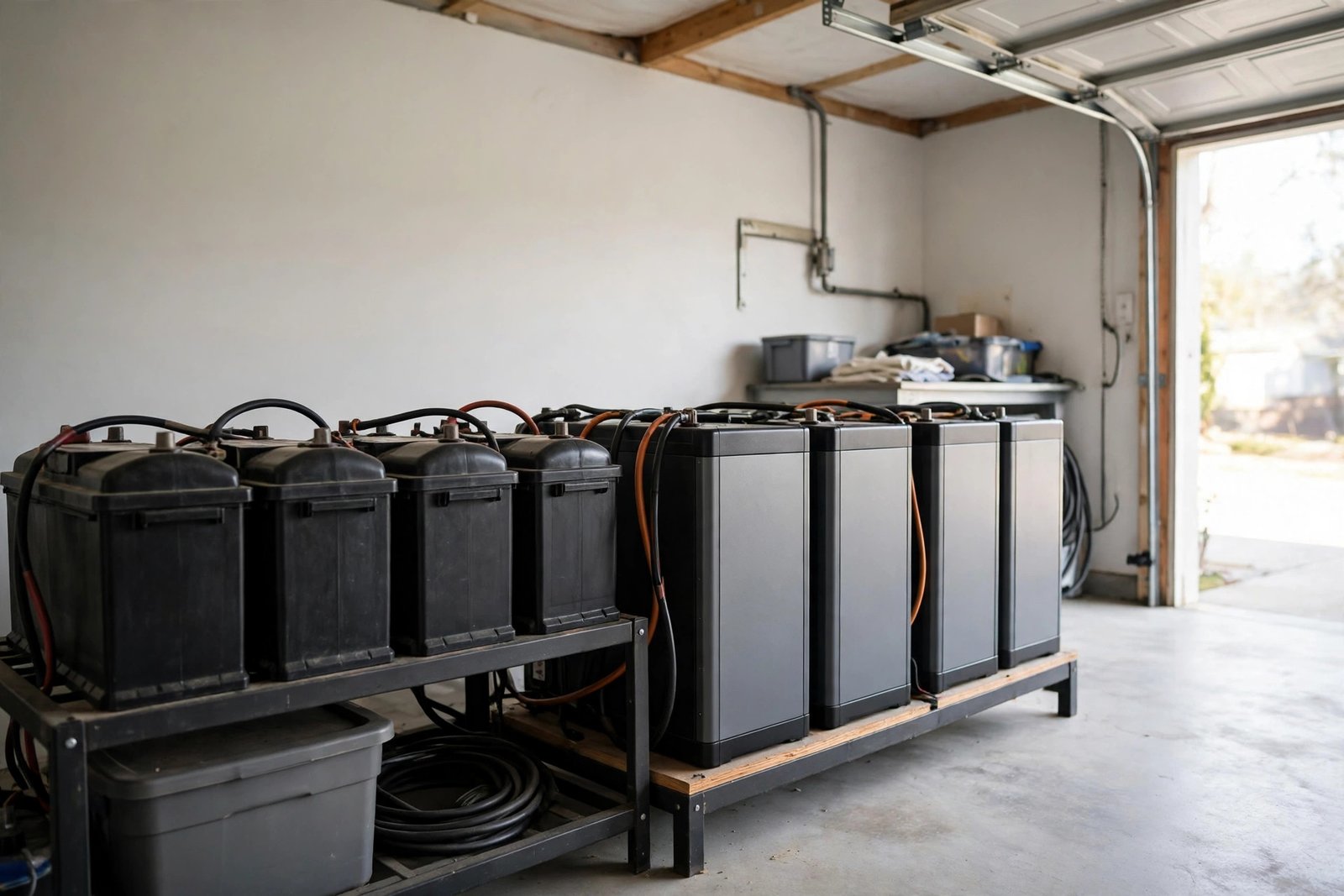
Most home solar systems use one of three battery types. Each has a different expected life, a different tolerance for deep discharge, and a different maintenance routine.
Lead-acid batteries (flooded)
Flooded lead-acid batteries are the oldest and cheapest type. They need regular maintenance — checking water levels, cleaning terminals, and occasional equalization charging. With good care, a flooded lead-acid battery typically lasts 3 to 5 years, and sometimes up to 7 years in a well-managed system. Their main weakness is that deep discharges damage them quickly: draining one below half its capacity on a regular basis can cut its life in half. They are also sensitive to heat and to being left in a discharged state.
Sealed lead-acid batteries (AGM and gel)
AGM and gel batteries are sealed, so they do not need water top-ups and cannot spill. They are more convenient than flooded batteries and handle vibration better, but their lifespan is similar — typically 4 to 7 years. They are slightly more tolerant of deep discharge than flooded batteries, but they are more sensitive to overcharging, so a correctly set charge controller matters even more.
Lithium batteries (lithium iron phosphate / LiFePO4)
Lithium iron phosphate batteries are the most common lithium type in home solar systems. They cost more up front but last much longer — typically 10 to 15 years, or several thousand cycles. They can be discharged much more deeply without damage, they hold their voltage steady as they run down, and they need almost no maintenance. Their main enemies are charging below freezing and poor-quality battery management systems, so they still need a proper installation and a compatible charger.
| Battery type | Typical lifespan | Usable capacity per cycle | Maintenance |
|---|---|---|---|
| Flooded lead-acid | 3–7 years | About 50% | Regular: water, terminals, equalization |
| Sealed lead-acid (AGM / gel) | 4–7 years | About 50–60% | Minimal: keep clean and cool |
| Lithium (LiFePO4) | 10–15 years | About 80–90% | Almost none |
These figures are typical ranges for home systems, not guarantees. A battery that is treated well can outlive the top of its range; one that is abused can fail well before the bottom of it.
What Shortens a Solar Battery’s Life
Batteries do not usually fail suddenly for no reason. Most early failures come down to a handful of causes, and most of them are within your control.
- Deep discharges: Regularly draining a lead-acid battery below half its capacity is the fastest way to shorten its life. Lithium batteries cope far better, but even they last longer when they are not emptied every night.
- Heat: High temperatures speed up the chemical reactions inside a battery. A battery kept in a hot garage or a sun-baked shed will age noticeably faster than one kept in a cool, shaded room.
- Leaving it discharged: A lead-acid battery left flat for days or weeks can develop sulphation — crystals that coat the plates and permanently reduce capacity. This is one of the most common causes of early lead-acid failure.
- Overcharging: Charging at too high a voltage boils off water in flooded batteries and can damage sealed batteries and lithium cells. A charge controller with the wrong settings is a common culprit.
- Too little charging: A battery that never gets fully charged — for example, in a system with too few panels for the load — slowly loses capacity, a condition sometimes called chronic undercharging.
- Poor connections: Corroded or loose terminals cause voltage drop, uneven charging, and heat at the connection, all of which wear the battery out faster.
- Age itself: Even a battery that is treated perfectly will gradually lose capacity. The internal plates and materials simply wear out over time and cycles.
Depth of Discharge: The Biggest Factor You Can Control
Depth of discharge (DoD) means how much of a battery’s stored energy you use before recharging it. Using 50% of a battery’s capacity is a 50% depth of discharge; using all of it is 100%.
For lead-acid batteries, this number matters enormously. A flooded lead-acid battery discharged to only 30% each day might last several thousand cycles, while the same battery discharged to 80% every day might last only a few hundred. That is why installers usually size lead-acid battery banks so that normal nightly use only takes about half the stored energy — the other half is a reserve that protects the battery’s life.
Lithium batteries are far more forgiving. Most lithium solar batteries are designed to be discharged to 80% or even 90% regularly, and they still deliver thousands of cycles. This is one of the main reasons a lithium battery can be smaller than a lead-acid battery for the same usable energy.
What this means in practice: if your lead-acid battery is regularly empty by morning, your battery bank is probably too small for your nightly load, or your panels are not recharging it fully during the day. Adding capacity — or reducing the load — will usually extend the battery’s life more than any other single change.
Temperature: Heat and Cold Both Matter
Batteries are happiest at moderate temperatures, roughly between 15°C and 25°C (59°F and 77°F). Outside that range, their life shortens.
Heat is the bigger enemy. As a rough guide, every sustained rise of around 10°C above room temperature can roughly halve a lead-acid battery’s life. A battery bank in a garage that reaches 35°C or more on summer afternoons will age much faster than the same bank in a cool utility room. If your batteries are in a hot location, shading the room, improving ventilation, or moving them to a cooler spot can add years to their life.
Cold does not usually damage a battery permanently, but it reduces the energy a battery can deliver — a lead-acid battery can lose a noticeable share of its capacity in freezing weather. Lithium batteries have a different cold problem: charging them below freezing can cause permanent damage, which is why good lithium systems include a battery management system that prevents charging in very cold conditions.
If you live in a region with hot summers or cold winters, check your battery’s datasheet or manual for its recommended temperature range, and try to keep the battery room within it. Insulation, ventilation, and keeping batteries out of direct sunlight are simple, effective steps.
Signs Your Solar Battery Is Failing
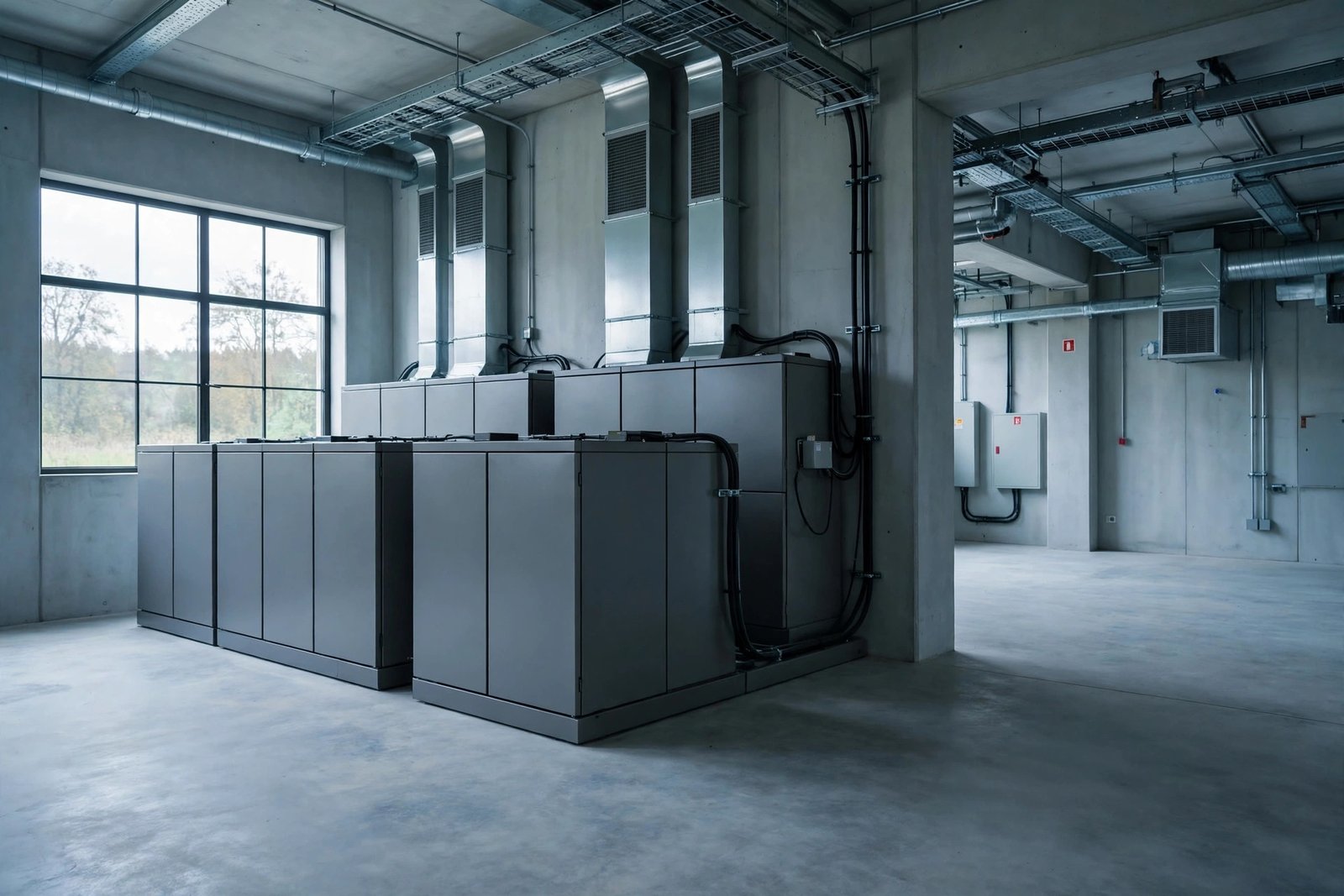
A battery rarely dies overnight. It usually gives warning signs for weeks or months first. Watch for these:
- Much shorter backup time: The battery used to run your lights and fridge through the night, but now it is empty by midnight — even though your usage has not changed. This is the most reliable sign of lost capacity.
- Voltage drops quickly under load: The battery reads a healthy voltage when idle, but the voltage falls sharply as soon as a load is switched on, and the inverter may cut out or alarm.
- It charges unusually fast: A battery that reaches “full” in a fraction of the time it used to is often a battery that can no longer hold much charge — it is full because there is very little room left inside.
- It needs charging more often: The system used to charge once a day; now the charge controller is cycling on and off, or the battery never seems to reach a full charge.
- Swollen or bulging case: A battery case that is swollen, warped, or cracked has suffered internal damage — usually from overcharging or heat. Stop using it and get it checked.
- Corrosion, leaks, or a strong smell: Heavy corrosion on the terminals, leaking fluid, or a rotten-egg smell from a lead-acid battery are all signs of a battery in trouble.
- One battery in a bank is much hotter than the others: A single hot battery in a bank usually means that one unit is failing and dragging the rest down.
- The inverter alarms or shuts down at night: Low-voltage cut-offs that trigger earlier and earlier in the evening usually point to a battery that can no longer deliver its rated energy.
One of these signs on its own may have a simple cause — a dirty terminal, a loose cable, or a seasonal change in sunlight. Several of them together, especially in a battery that is already past its expected lifespan, usually mean the battery itself is wearing out.
How to Test Your Battery’s Health
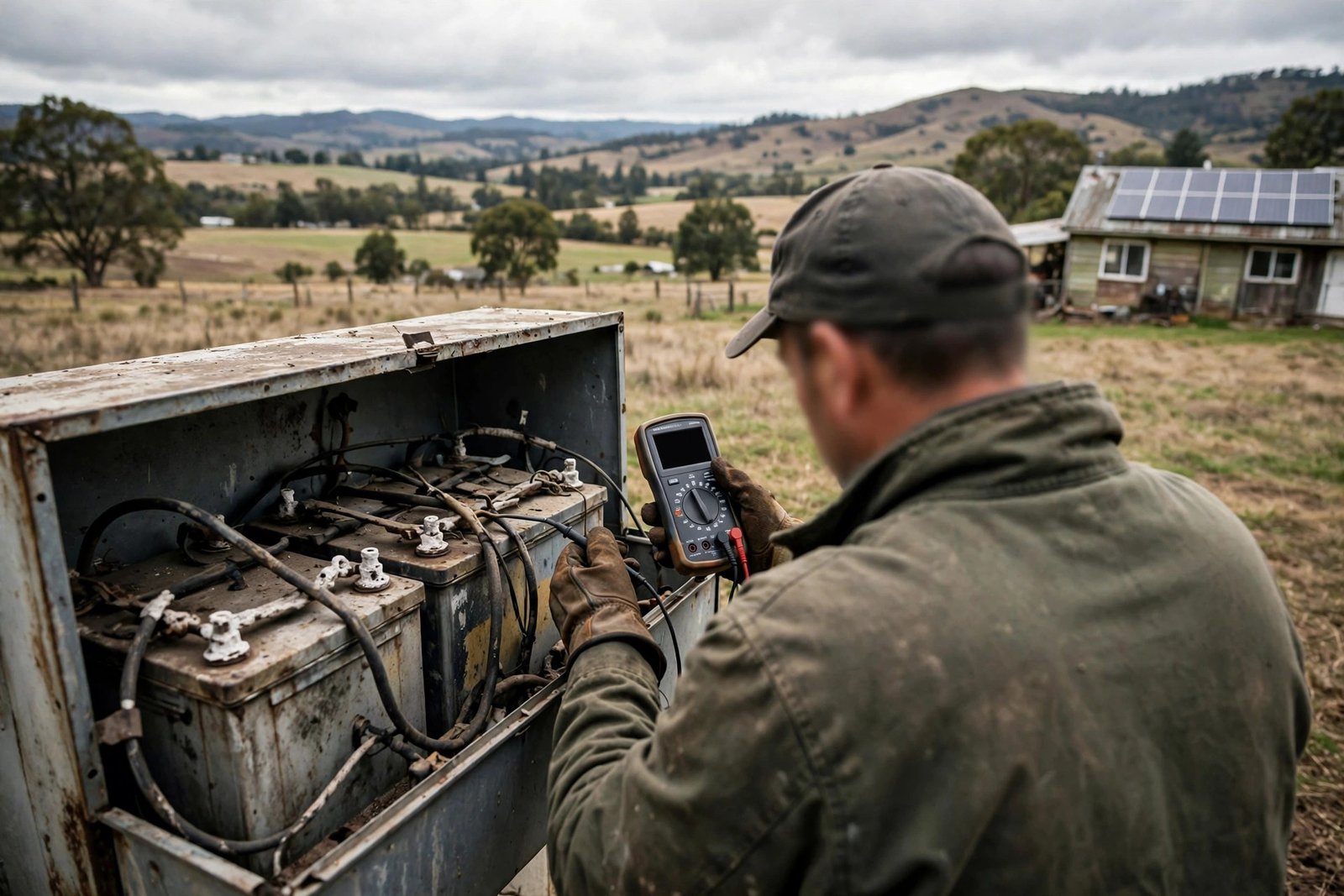
Before you decide a battery is finished, test it. A few simple checks can tell you whether the battery is the problem or whether something else in the system is at fault.
1. Check the voltage at rest
After the battery has been fully charged and left to rest with no load for a few hours, measure the voltage with a multimeter. Compare the reading with the voltage chart in your battery’s manual — a healthy, fully charged 12V lead-acid battery should read around 12.6–12.8V at rest, while a reading well below that suggests the battery is not holding a full charge. Lithium batteries hold a steadier voltage, so a voltage reading alone is less informative for them; their battery management system usually reports a state of health instead.
2. Watch the voltage under load
Switch on a known load — a light or a fan, for example — and watch the voltage. A healthy battery’s voltage dips slightly and then steadies. A failing battery’s voltage drops sharply and keeps falling.
3. Time a real discharge
Note how long the battery powers a typical evening load compared with when it was new. If the backup time has fallen by a third or more, the battery has lost a significant share of its capacity.
4. Check the specific gravity (flooded lead-acid only)
A hydrometer measures the specific gravity of the electrolyte in each cell. Cells that read much lower than the others indicate a weak or damaged cell. If you are not comfortable opening battery caps and handling electrolyte, leave this test to a technician.
5. Look at your monitoring data
If your system has a monitoring app or display, look at the charge and discharge curves over the last few weeks. A battery that charges to full quickly and discharges quickly is showing the classic pattern of lost capacity. Our guide to reading your solar monitoring data explains what to look for.
Always wear gloves and eye protection when working around batteries, and never test a battery that is swollen, leaking, or hot to the touch — get a professional to look at it instead.
How to Make Your Solar Battery Last Longer
You cannot stop a battery from ageing, but you can slow it down considerably. These habits make the biggest difference:
- Keep discharges shallow: Aim to use no more than half of a lead-acid battery’s capacity on a normal night. For lithium, avoid emptying it completely every night if you can.
- Recharge fully and regularly: Let the battery reach a full charge most days. A lead-acid battery that is never fully charged slowly loses capacity.
- Keep it cool: Shade the battery room, ventilate it, and keep batteries out of direct sunlight. A few degrees cooler can mean a year or two more life.
- Clean the terminals: Corrosion on terminals causes voltage drop and uneven charging. Clean them regularly and keep connections tight. See our guide on cleaning solar battery terminals.
- Check water levels (flooded lead-acid): Top up with distilled water when the level is low, and never let the plates sit exposed. Our guide to checking lead-acid battery water levels walks through the process.
- Equalize when recommended: Some flooded lead-acid batteries benefit from occasional equalization charging, which balances the cells. Only do this if your battery’s manual recommends it — see our guide on equalization charging.
- Match the charger settings: Make sure your charge controller or inverter is set to the correct battery type and voltage. Wrong settings are a common cause of both overcharging and undercharging.
- Reduce the night load: Shifting heavy use to daylight hours, when the panels are producing, takes pressure off the battery. Our guide to using solar power at night without draining your battery has practical ideas.
Repair or Replace? Making the Decision
Not every failing battery needs replacing. Work through these questions first:
- Is the battery still within its expected lifespan? A 3-year-old lithium battery with poor backup probably has a fixable problem elsewhere. A 7-year-old lead-acid battery showing the same symptoms is probably just worn out.
- Is the problem in one cell or one battery? In a bank of batteries, a single bad unit can drag the whole bank down. Replacing just that unit — with an identical one — can restore the bank, though mixing very old and brand-new batteries in one bank is not ideal.
- Have you ruled out the cheap fixes? Dirty terminals, low water levels, wrong charge settings, and a failing charge controller can all mimic a dying battery. Check and fix those first.
- How much capacity is left? If the battery still delivers most of its original backup time, it may be worth keeping for another year. If it delivers less than half, replacement is usually the better investment.
- What would a new battery save you? A battery that dies every evening forces you to buy grid power or run a generator. Compare the cost of a replacement with what you are spending — or losing — by keeping a worn-out battery.
If the battery is swollen, leaking, cracked, or very hot, do not try to repair it or keep using it. Disconnect it safely and have a professional remove it.
What to Know Before You Replace a Battery
When replacement is the right call, a little planning saves money and avoids a repeat failure.
- Check the warranty first: Many batteries carry a warranty of 5 to 10 years. If yours is still covered, contact the supplier before buying a replacement — a warranty claim may cover part or all of the cost.
- Consider switching types: If your lead-acid bank has failed early, a lithium replacement may cost more up front but last two or three times longer and need almost no maintenance. Check that your inverter and charge controller support lithium before switching.
- Size it for your real use: Look at your actual nightly consumption, not the size of the old bank. A bank that was too small is often the reason the old battery died early.
- Replace the whole bank together: In a bank of batteries, replacing only one old unit with a new one creates an imbalance — the new battery ends up doing more work and ages faster. If the bank is old, replace all units at the same time.
- Check compatibility: The replacement must match your system’s voltage, and your charge controller must have the right settings for the new battery type. Your installer or the battery supplier can confirm this.
- Dispose of the old battery properly: Solar batteries contain lead and acid, or lithium cells, and must not go in household waste. Most suppliers and scrap dealers will take old batteries for recycling, and in many areas they have value as scrap.
Safety Reminders
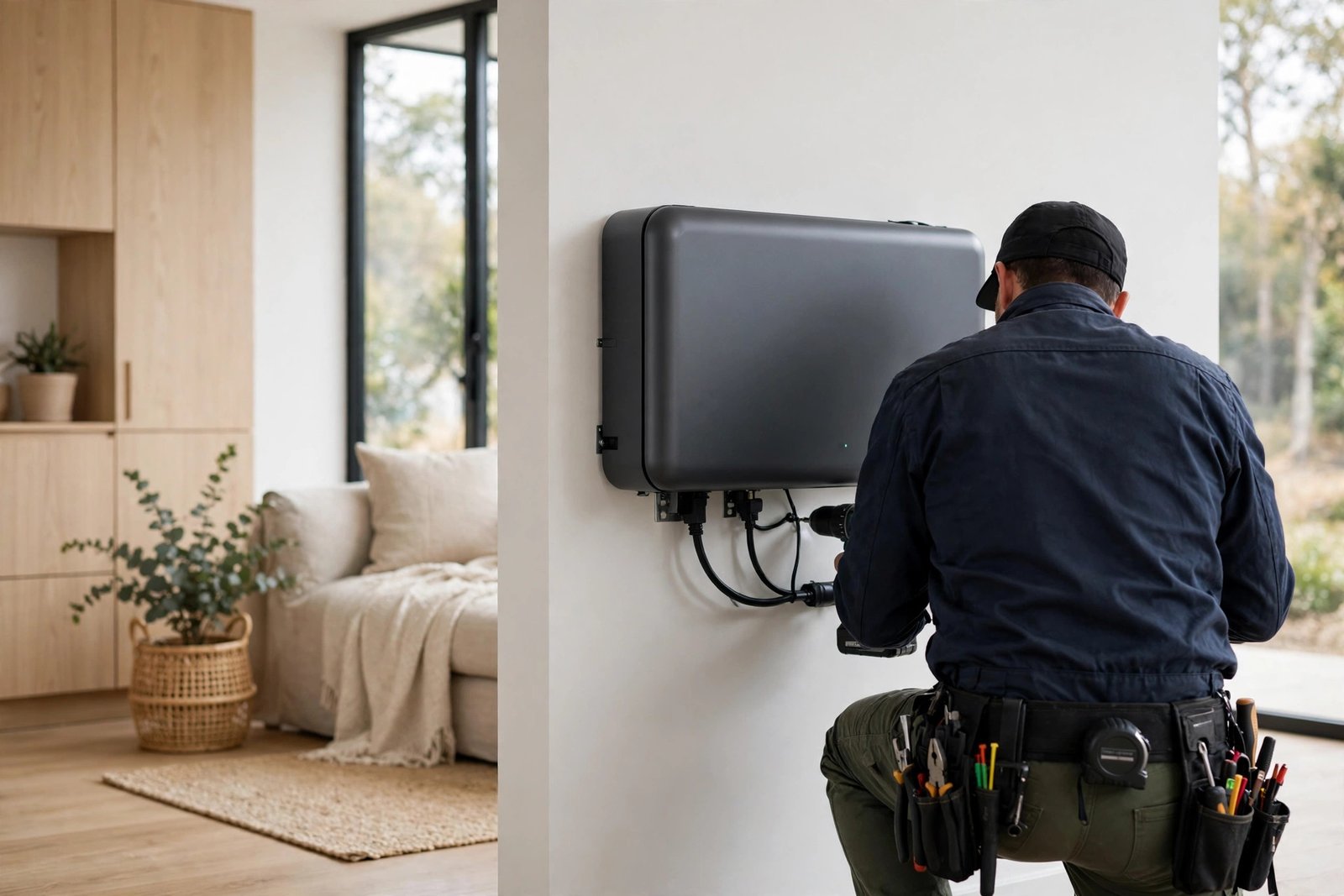
Solar batteries store a large amount of energy and demand respect. Lead-acid batteries contain sulphuric acid, which burns skin and eyes, and they can release hydrogen gas while charging — so never smoke or create sparks near them, and keep the battery room ventilated. Lithium batteries can catch fire if punctured, short-circuited, or charged incorrectly, and a lithium fire is very hard to extinguish.
Never short-circuit a battery’s terminals, never connect batteries of different types, voltages, or ages in the same bank, and never open a sealed battery. Always disconnect the solar panels and the load before working on battery connections, wear gloves and eye protection, and keep a fire extinguisher rated for electrical fires nearby. If a battery is swollen, leaking, smoking, or hot to the touch, leave the area, ventilate if it is safe to do so, and call a professional — do not try to move it yourself.
When to Call a Professional
Call a qualified solar technician or electrician if any of the following apply:
- The battery is swollen, cracked, leaking, smoking, or very hot.
- You are unsure which battery type you have or which replacement is compatible with your system.
- The battery needs replacing — a professional will size the new bank, set the charge controller correctly, and dispose of the old battery safely.
- Your monitoring data shows a fault you cannot explain, or the inverter keeps shutting down at low voltage.
- You are considering switching from lead-acid to lithium, which may need changes to the charger, inverter settings, or wiring.
- You do not have the tools or the confidence to test battery voltage and connections safely.
Battery work involves high currents and, in the case of lead-acid, corrosive acid. If you are unsure about any step, the cost of a technician’s visit is small compared with the cost of a ruined battery bank — or an injury. Our guide to DIY solar repair vs hiring a pro explains which jobs are safe to tackle yourself and which are not.
FAQs
How long should a solar battery last?
It depends on the type. Lead-acid batteries typically last 3 to 7 years, sealed lead-acid (AGM or gel) 4 to 7 years, and lithium iron phosphate batteries 10 to 15 years. How deeply you discharge the battery, the temperature where it is stored, and how well it is maintained all affect the real lifespan.
What is the average lifespan of a lithium solar battery?
Most lithium iron phosphate batteries used in home solar systems are rated for 10 to 15 years, or several thousand charge cycles. In practice, a well-installed lithium battery that is not regularly emptied completely and is kept at moderate temperatures should reach the upper end of that range.
How do I know if my solar battery needs replacing?
The clearest signs are much shorter backup time than the battery used to give, voltage that drops quickly when a load is switched on, a battery that reaches “full” suspiciously fast, and visible damage such as swelling, corrosion, or leaks. If several of these appear together in a battery past its expected lifespan, replacement is usually the right call.
Can a solar battery be repaired, or does it have to be replaced?
Some problems can be fixed: dirty terminals, low water levels in flooded lead-acid batteries, wrong charger settings, and a single bad battery in a bank. But a battery that has lost a large share of its capacity through age, sulphation, or deep-cycle wear cannot be restored to its original performance — replacement is the only real fix.
Is it worth replacing a lead-acid battery with lithium?
Often, yes. Lithium costs more up front but lasts two to three times longer, can be discharged more deeply, and needs almost no maintenance. Check first that your inverter and charge controller support lithium batteries and that the charging settings can be changed to suit them.
Why does my solar battery die so fast at night?
Common causes include a battery that has lost capacity through age, a battery bank that is too small for your nightly load, and heavy appliances running after sunset. Start by testing the battery’s voltage under load and comparing your actual night-time usage with the battery’s usable capacity.
Does cold weather shorten a solar battery’s life?
Cold reduces the energy a lead-acid battery can deliver, but it does not usually cause permanent damage. Lithium batteries are different: charging them below freezing can cause permanent harm, so a good battery management system will prevent charging in very cold conditions. Heat is the bigger long-term enemy for all battery types.
Conclusion
A solar battery’s lifespan is not a fixed number — it is the result of the battery type you own and the way you treat it. Lead-acid batteries typically give you 3 to 7 years, while lithium batteries usually last 10 to 15 years, and careful use can push either type toward the top of its range. Keep discharges shallow, keep the battery cool and fully charged, clean the terminals, and check the water in flooded batteries, and you will get the most from your investment.
When the signs of failure start to stack up — shorter backup, fast voltage drops, swelling, or corrosion — test the battery before you write it off. Simple problems such as dirty terminals or wrong charge settings can look just like a dying battery and cost almost nothing to fix. But when the battery has genuinely lost most of its capacity and is past its expected life, replacing it — preferably the whole bank at once — is the sensible move, and a switch to lithium is worth considering if your system supports it.
If you are unsure about your battery’s condition, or the battery shows any sign of damage, get a qualified solar technician to check it. A short professional visit costs far less than a ruined battery bank, and it keeps your home and your system safe.
Pingback: Solar Battery Not Holding Charge After a Full Day of Sun? Causes and Fixes - Solar Fixing Guide