
Quick answer: In most cases, yes — a standard homeowners insurance policy covers solar panels that you own and that are attached to your roof, as part of your home’s structure. Damage from sudden events such as hail, wind, fire, lightning, or a falling tree is usually covered, while gradual problems such as wear and tear, poor installation, or a manufacturing defect are not. Leased panels are normally covered by the leasing company’s own insurance, not yours. Always check your own policy wording, because coverage, deductibles, and payout limits vary — and telling your insurer about your solar system when it is installed is one of the most important steps you can take.
Table of Contents
- Are Solar Panels Covered by Homeowners Insurance?
- What Damage Is Usually Covered?
- What Is Usually Not Covered?
- Owned, Leased, or Financed Panels
- How Much Will Your Insurer Pay?
- Typical Repair and Replacement Costs
- What to Do Right After the Damage Happens
- How to File a Solar Panel Insurance Claim Step by Step
- Working With the Insurance Adjuster
- What to Do If Your Claim Is Denied
- Warranty or Insurance — Which One Pays?
- When to Call a Professional
- FAQs
- Conclusion
Are Solar Panels Covered by Homeowners Insurance?
For most homeowners, the short answer is yes. A standard homeowners insurance policy protects the structure of your home — the roof, walls, and everything permanently attached to them. Rooftop solar panels that you own are generally treated as part of that structure, so they fall under the same dwelling coverage that protects your roof itself.
That said, “covered” does not mean “covered for everything.” Your policy protects you against specific sudden and accidental events, which insurers call perils. It does not act as a maintenance plan or a warranty. Understanding the difference between a covered peril and an excluded problem is the key to knowing whether your claim will succeed.
There is one more thing to check before anything goes wrong: whether your insurer knows you have solar panels at all. Many policies require you to tell your insurer about major additions to your home, and a solar array is a major addition. If your insurer does not know the panels exist, your claim can be delayed or disputed. If you have not told them yet, do it now — before a storm arrives.
What Damage Is Usually Covered?
Most standard homeowners policies cover solar panels against the same perils that cover the rest of your home. The exact list depends on your policy, but these are the events that are commonly covered:
Hail damage
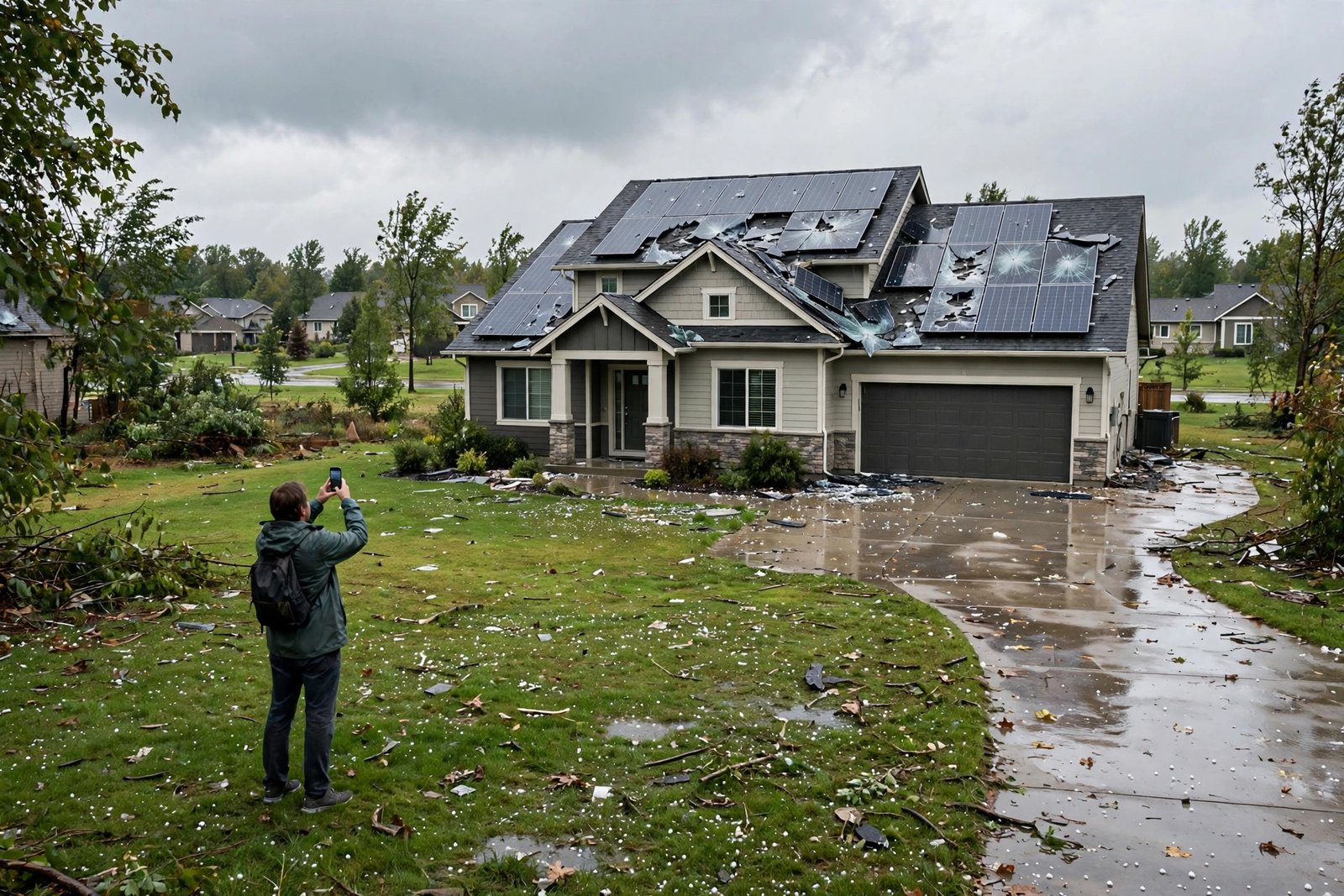
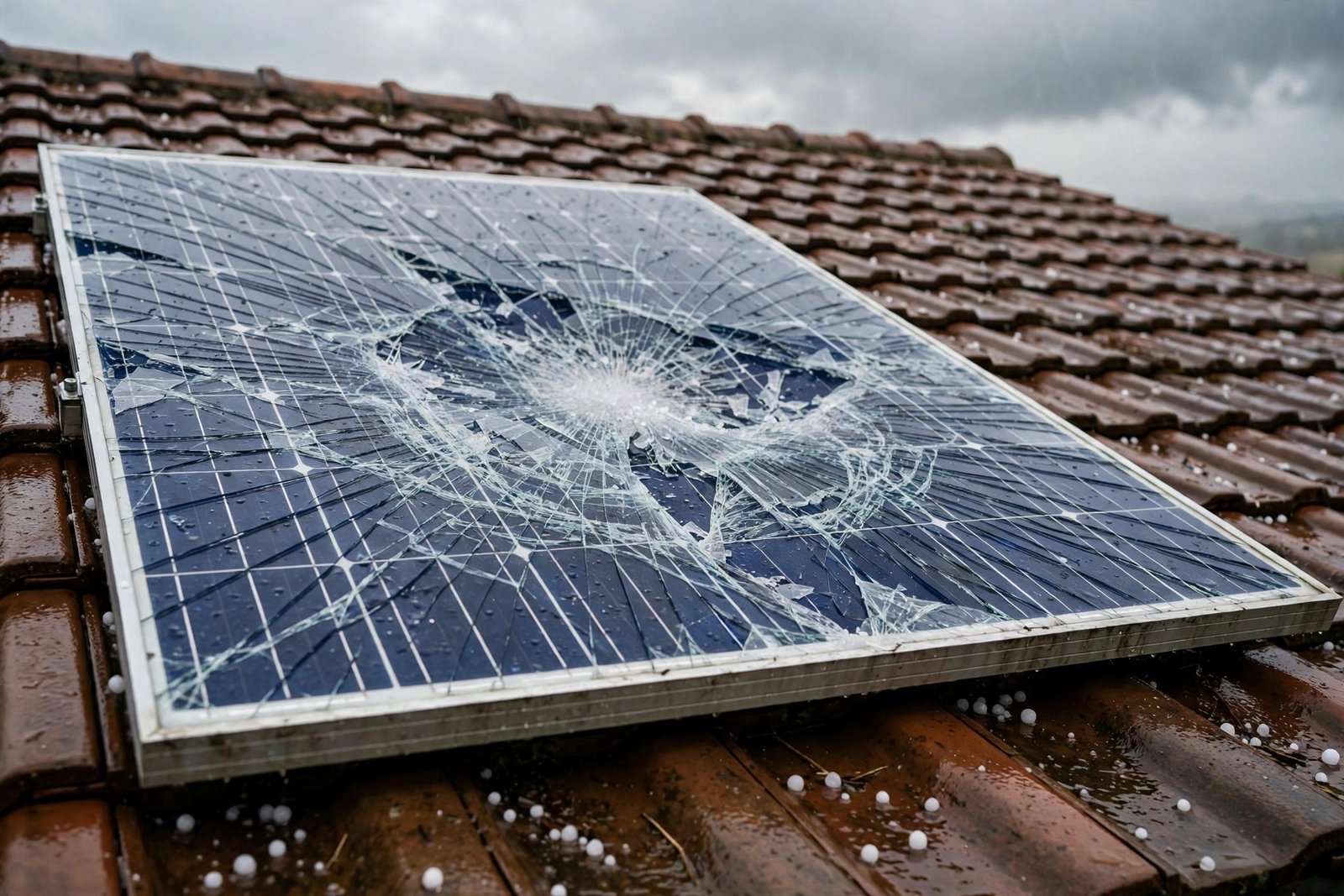
Hail is one of the most common causes of solar panel insurance claims. Modern panels are tested to survive hailstones of a certain size, but a severe hailstorm can still crack the glass, damage the frame, or break the cells underneath. Cracked glass, spider-web patterns across the surface, and panels that stop producing power after a hailstorm are typical signs of a covered loss.
Wind and storm damage
High winds can lift panels, bend mounting rails, or tear an entire section of an array off the roof. Heavy storms can also throw debris — branches, roof tiles, garden furniture — into the panels. Damage caused by wind, hurricanes, tornadoes, and severe thunderstorms is normally covered, provided the panels were installed properly in the first place.
Fire and lightning
If a fire damages your panels, whether it starts inside the house or spreads from outside, it is normally a covered event. Lightning strikes are also usually covered, including damage to the inverter and other system components that a surge can destroy. See our guide on how much it costs to replace a broken solar inverter if the inverter is the part that failed.
Falling objects and trees
A tree or large branch falling onto your roof and panels is a classic covered claim. The same applies to other falling objects, such as a neighbour’s fence panel or debris blown in by a storm. In most policies, the insurer will also pay for removing the tree from the roof so the repair can begin.
Theft and vandalism
Solar panels are rarely stolen from a roof, but it does happen, and vandalism — such as panels deliberately smashed — is normally covered too. Ground-mounted panels in an accessible garden are more vulnerable than rooftop ones, so check how your policy treats them.
Weight of snow and ice
In colder regions, heavy snow or ice can damage panels or their mounts. Many policies cover damage from the weight of snow and ice, but some exclude it, so this is one peril worth checking in your own policy wording.
What Is Usually Not Covered?
Just as important as knowing what is covered is knowing what is not. These are the problems homeowners most often assume are covered, only to find out they are not:
- Wear and tear and gradual degradation: Panels lose a small amount of output every year. That slow decline is normal ageing, not damage, and no insurer pays for it. Gradual performance loss is a matter for your performance warranty, not your insurance.
- Manufacturing defects: If a panel fails because it was badly made — faulty cells, weak lamination, a junction box that fails — that is the manufacturer’s responsibility under the product warranty, not your insurer’s.
- Poor installation: Damage caused by bad workmanship, such as panels mounted incorrectly or wiring installed the wrong way, is not covered. The installer is responsible for their own work, and their workmanship warranty or liability insurance should cover it.
- Lack of maintenance: Damage that happens because the system was not maintained — for example, a mounting that corroded over years without inspection — is usually excluded.
- Flooding: Standard homeowners policies generally do not cover flood damage. If you live in a flood-prone area, flood cover usually needs a separate policy, and that policy may or may not include ground-mounted panels.
- Earthquakes: In many regions, earthquake damage is excluded from standard policies and needs separate cover.
- Damage during installation or removal: If panels are damaged while they are being installed, moved, or taken off the roof, that is usually the installer’s responsibility, not a homeowners claim. If your roof needs repair, read our guide on solar panel removal and reinstallation costs for roof repairs before agreeing to any work.
Every policy has its own exclusions list. Reading it once, when you take out the policy or when panels are installed, is far cheaper than discovering an exclusion after the damage has happened.
Owned, Leased, or Financed Panels
Whether your panels are covered — and by whose insurance — depends on how you got them.
Panels you own outright
If you bought your system, either with cash or with a loan, the panels are your property and are normally covered by your homeowners policy as part of your home. If you financed the system, your lender may require you to keep the panels insured, but the claim still goes through your own policy.
Leased panels or a power purchase agreement (PPA)
If you lease your panels or have a PPA, you do not own them — the leasing company does. In that case the leasing company normally carries its own insurance on the equipment, and damage claims usually go through them, not through your homeowners policy. Your roof may still be your responsibility, though, so report the damage to both your insurer and the leasing company and let them sort out who pays for what. Read your lease carefully: some leases make you responsible for notifying the company promptly, and delays can affect their cover.
Ground-mounted panels
Panels mounted on the ground rather than on the roof are sometimes treated differently. Some policies cover them under dwelling coverage, others under “other structures” coverage, which may have a lower limit. A ground-mounted array is also easier to steal or vandalise. If your panels are ground-mounted, check the limit that applies — you may need to raise it.
How Much Will Your Insurer Pay?
Even when a claim is covered, the amount you receive depends on three things: your deductible, your coverage limit, and whether your policy pays replacement cost or actual cash value.
Your deductible
The deductible is the amount you pay yourself before the insurer pays anything. If your deductible is $1,000 and the repair costs $4,000, the insurer pays $3,000. If the repair costs less than your deductible, there is no point in claiming — and claiming for small amounts can push your premium up at renewal, so many homeowners pay for minor repairs themselves.
Replacement cost vs actual cash value
This is the most important detail in your policy. A replacement cost policy pays what it costs to replace the damaged panels with new ones of similar quality, without deducting for age. An actual cash value policy pays the replacement cost minus depreciation — what your panels are worth now, after years of use. For a ten-year-old system, the difference can be thousands of dollars. If your policy pays actual cash value, ask your insurer what it would cost to upgrade to replacement cost cover.
Coverage limits
Your dwelling coverage limit is the maximum the insurer will pay to rebuild your home. Solar panels increase the value of your home, so if you installed panels without increasing that limit, the cover may not be enough to replace both the roof and the panels after a major loss. Tell your insurer the value of the system when it is installed and ask them to confirm in writing that the limit is adequate. This can also affect your premium — solar panels may raise it slightly, but that is a small price for proper cover.
Typical Repair and Replacement Costs
Insurers and adjusters work from real repair costs, so it helps to know roughly what repairs cost. These are typical ranges in the USA and UK and vary widely by system size, panel type, and local labour rates — get a written quote from a qualified installer for your own system.
| Repair or replacement | Typical cost range |
|---|---|
| Replace one damaged panel | $200 – $600 per panel (plus labour) |
| Replace several panels after hail | $1,000 – $5,000+ |
| Replace a damaged inverter | $1,000 – $3,000+ |
| Repair or replace mounting rails | $300 – $1,500 |
| Remove and reinstall panels for roof repair | $1,500 – $4,000 |
| Full residential system replacement | $10,000 – $25,000+ |
For a detailed breakdown of common fixes, see our solar panel repair cost guide.
What to Do Right After the Damage Happens
The hours after a storm are when your claim is won or lost. Follow these steps in order:
- Stay safe first. Do not climb onto a damaged roof, and never touch a damaged panel, exposed wiring, or a loose mounting rail. A damaged panel can still produce voltage in daylight, and a cracked panel can have sharp edges. If there is water inside the house, a burning smell, or sparking, turn off the system at the main isolator if you can do so safely from the ground, and call a qualified electrician or your installer immediately.
- Prevent further damage. Insurers expect you to take reasonable steps to stop the damage getting worse — for example, covering a hole in the roof with a tarp. Keep the receipts for anything you buy, because those costs are often claimable. Do not start permanent repairs before the adjuster has seen the damage.
- Photograph everything. Take wide photos of the whole roof and array, close-ups of each damaged panel, photos of the inverter and any damaged wiring, and photos of any interior damage such as water stains. Photograph from the ground or a window — never climb up to get a better angle. Date-stamped photos from your phone are ideal.
- Save your monitoring data. Screenshot your monitoring app showing the drop in output, and note the date and time the output fell. This is strong evidence that the panels were working before the event and stopped afterwards. Our guide on reading your solar monitoring data explains what to look for.
- Do not throw anything away. Keep broken panels, damaged mounts, and failed components until the adjuster has inspected them. A damaged panel is evidence — once it is gone, so is your proof.
How to File a Solar Panel Insurance Claim Step by Step
Filing a claim is a process, not a single phone call. Working through it methodically gives you the best chance of a fair settlement.
Step 1: Check your policy
Before you call your insurer, read your policy’s dwelling coverage, exclusions, and deductible. Note whether your policy pays replacement cost or actual cash value, and whether your panels are listed or the coverage limit reflects their value. If anything is unclear, write your questions down for the call.
Step 2: Contact your insurer promptly
Most policies require you to report damage within a set time, often within days. Call the claims line, explain that your solar panels were damaged, and say what caused it — hail, wind, a falling tree. Write down the claim number, the name of the person you spoke to, and the date and time of the call. Ask what the insurer needs from you and how the process will work.
Step 3: Gather your documents
Insurers ask for proof of what you owned, what it was worth, and what happened. Collect these before the adjuster visits:
- Photos and videos of the damage, plus any monitoring-app screenshots showing the drop in output
- The original purchase invoice or contract for the solar system, showing the installation date and cost
- The product and performance warranty documents — see our guide on how to claim your solar panel warranty for what to keep
- The installation certificate and any inspection reports
- Any previous repair or maintenance records
- Receipts for temporary repairs or tarps you bought to prevent further damage
Step 4: Get a written repair quote
Ask a qualified solar installer — ideally your original installer — for a written quote for the repair or replacement. A professional quote carries far more weight than a rough estimate. If panels need to come off the roof, make sure the quote covers removal, storage, reinstallation, and any roof repair underneath. If the installer finds damage the adjuster missed, such as a cracked panel that still looks fine from the ground, ask them to put it in writing.
Step 5: Meet the adjuster
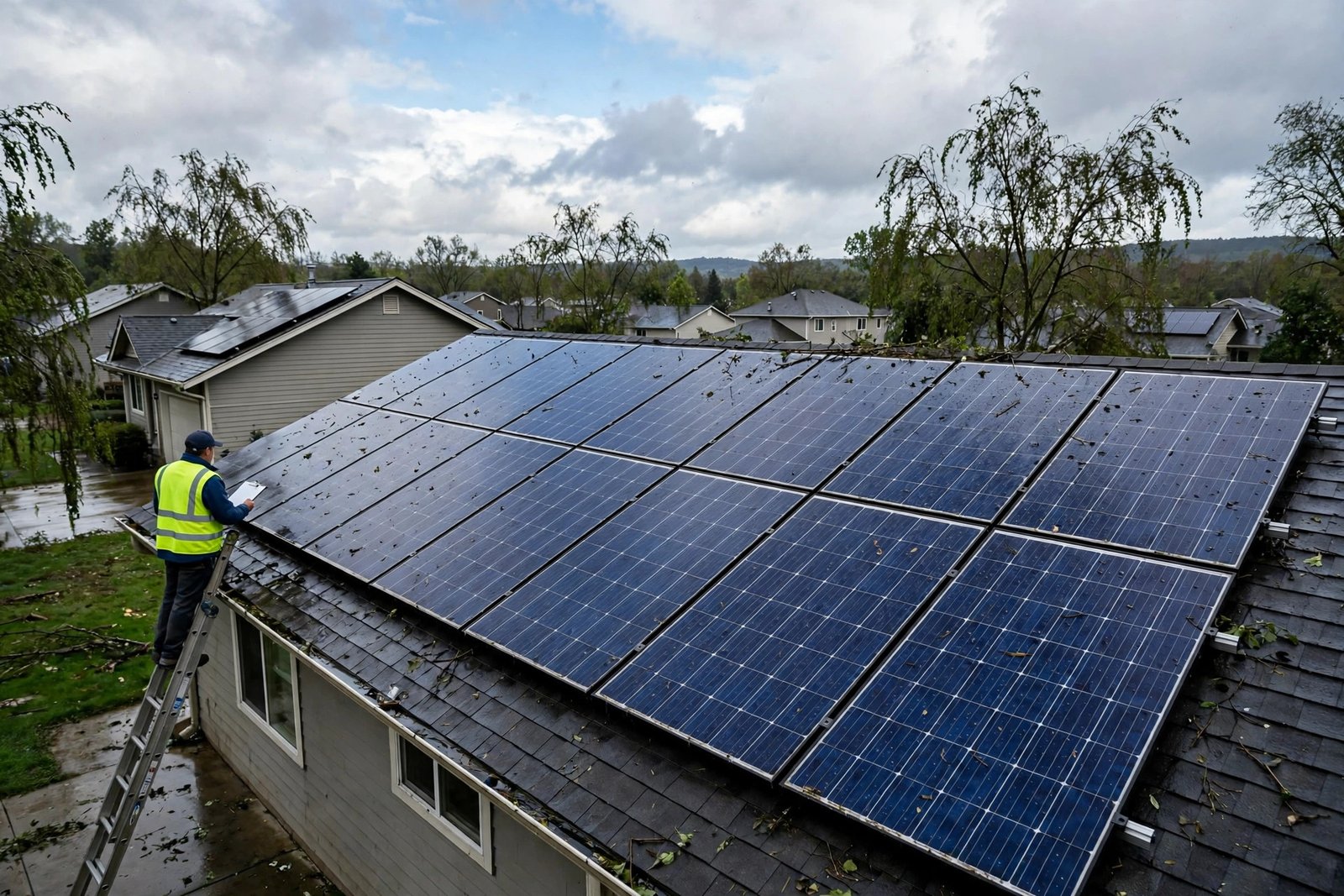
The insurer will send an adjuster to inspect the damage. Be present if you can, and have your installer there too if possible — an installer can point out damage that a general adjuster may not recognise, such as micro-cracks that only show up in output data. Walk the adjuster through the photos and the quote, and make sure every damaged panel is counted, not just the obviously broken ones.
Step 6: Review the settlement offer
When the insurer makes an offer, compare it line by line with your installer’s quote. Check that it covers the panels, the inverter if it was damaged, the mounting, the labour, and the cost of removing and reinstalling panels if the roof needs work. If the offer is lower, ask the insurer to explain the difference in writing.
Step 7: Approve the repair
Once you accept the settlement, your installer can begin the repair. Keep all invoices, and if the repair uncovers extra damage — such as water damage under a panel that was not visible before — tell your insurer immediately, before the work continues. A supplementary claim is normal and much easier to make while the repair is still in progress.
Working With the Insurance Adjuster
The adjuster’s job is to assess the damage fairly and work out what the policy owes you. A few habits make the process smoother:
- Be organised. Hand over your photos, invoices, and the installer’s quote in a single folder, paper or digital. An adjuster who can see the full picture quickly is more likely to assess it fully.
- Do not exaggerate, but do not minimise either. Describe the damage honestly and completely. Point out panels that look intact but have stopped producing — output data proves it.
- Ask questions. If the adjuster says something is not covered, ask them to show you the exact policy wording. If you disagree, you can ask for the decision in writing.
- Keep a record. Note the date of every call and visit, who you spoke to, and what was agreed. If the claim drags on, that record becomes your timeline.
What to Do If Your Claim Is Denied
A denied claim is not always the end of the story. Many denials are overturned, but only if you act on them properly:
- Ask for the denial in writing, with the exact policy clause the insurer is relying on. Read that clause yourself — denials sometimes rest on a clause that does not actually apply to your situation.
- Supply more evidence. If the denial says the damage was pre-existing or caused by wear and tear, a dated monitoring screenshot showing normal output the day before the storm, plus your installer’s written report, can change the decision.
- Ask for a second opinion. You can request a re-inspection, or hire an independent loss assessor. In the UK, you can also complain to the Financial Ombudsman Service if the insurer will not reconsider; in the USA, each state has an insurance regulator you can contact.
- Check the warranty route. If the insurer says the damage is a manufacturing defect, that may be true — and if so, the product warranty may pay instead. Read our comparison of product vs performance warranties to see which one applies.
- Do not sign a release you do not understand. If the insurer offers a partial settlement in exchange for closing the claim, make sure you understand what you are giving up before you accept.
Warranty or Insurance — Which One Pays?
Homeowners often confuse the two, and filing with the wrong one wastes weeks. The rule of thumb is simple:
- Insurance pays for sudden, external damage — hail, wind, fire, lightning, falling trees, vandalism.
- The product warranty pays for manufacturing defects — a panel that fails because it was badly made.
- The performance warranty pays for excessive output loss over time — a panel that still works but produces far less than it should after many years.
- The installer’s workmanship warranty pays for installation mistakes — bad mounting, wrong wiring, a leaking roof penetration.
Sometimes both apply at once. A hailstorm may crack a panel (insurance) and reveal that the mounting was installed incorrectly (installer). In that case, claim the storm damage from your insurer and take the installation fault up with your installer separately. If you are unsure which route applies, start with your installer — a good installer will tell you honestly whether the problem is damage, a defect, or their own work.
When to Call a Professional
Call a qualified solar technician or electrician immediately if:
- There is sparking, a burning smell, smoke, or scorch marks anywhere in the system
- Panels are loose, hanging, or have fallen — they can slide off the roof
- Wiring is exposed, cut, or hanging down
- Water is coming into the house through the roof where the panels are mounted
- The inverter shows a fault, has stopped working, or feels hot to the touch
- You are unsure whether the system is safe to leave switched on
Electrical safety warning: solar panels generate electricity whenever light falls on them, even if they are damaged or the system is switched off at the inverter. Never touch a cracked panel, exposed cable, or damaged connector, and never climb onto a roof that has been damaged by a storm. Leave all inspection and repair work on the roof to a qualified professional with the right safety equipment.
For storm preparation that can reduce the chance of a claim in the first place, read our guides on preparing your panels for hurricanes and high winds and post-storm solar inspection.
FAQs
Does homeowners insurance cover solar panels?
Yes, in most cases. Panels you own and that are attached to your roof are usually covered as part of your home’s structure, against sudden events such as hail, wind, fire, and lightning. Leased panels are normally covered by the leasing company’s own insurance instead.
Do I need to tell my insurer I have solar panels?
Yes. Tell your insurer when panels are installed, and ask them to confirm in writing that the system is covered and that the coverage limit reflects its value. If your insurer does not know the panels exist, a claim can be delayed or disputed.
Will claiming for solar panel damage raise my premium?
It can. A claim, especially a large one, may increase your premium at renewal. For small repairs that cost less than your deductible, it is usually better to pay yourself and not claim at all.
Does insurance cover solar panel damage from hail?
Yes, hail damage is one of the most common covered claims. Cracked glass, broken cells, and panels that stop producing after a hailstorm are normally covered, provided the panels were installed properly.
Does homeowners insurance cover solar panel removal for roof repairs?
It depends on why the roof is being repaired. If the roof damage is itself a covered event, such as storm damage, the cost of removing and reinstalling the panels is often included. If the roof work is routine maintenance, the removal cost is usually yours.
What is the difference between an insurance claim and a warranty claim?
Insurance covers sudden external damage, such as hail or a falling tree. A warranty covers defects in the product or a fall in performance over time. Filing with the wrong one wastes time, so check what actually caused the problem first.
What should I do if my solar panel insurance claim is denied?
Ask for the denial in writing with the exact policy clause cited, gather more evidence such as monitoring data and an installer’s report, and ask for a re-inspection. If the insurer still refuses, you can complain to your state insurance regulator in the USA or the Financial Ombudsman Service in the UK.
Conclusion
Homeowners insurance usually does cover damaged solar panels, as long as you own them, they are attached to your home, and the damage was caused by a sudden event such as hail, wind, fire, or a falling tree. What it does not cover is just as important: wear and tear, manufacturing defects, poor installation, and flooding are all somebody else’s responsibility — the warranty, the installer, or a separate flood policy.
The strongest position you can be in is a prepared one. Tell your insurer about your panels, check that your coverage limit reflects their value, and know whether your policy pays replacement cost or actual cash value. If damage happens, stay safe, photograph everything, save your monitoring data, get a written quote from a qualified installer, and file your claim promptly. And remember that insurance and warranty are two different safety nets — knowing which one to use can save you weeks of frustration and thousands of dollars.
Pingback: What to Do If Your Original Solar Installer Goes Out of Business - Solar Fixing Guide